
Broken masonry stands beside the farm buildings below Beinn Achaladair, where Achallader Castle once guarded the north end of Loch Tulla. The site is a ruined tower house, a fortified multi-storey residence, with a history bound up with Campbells, Fletchers, MacGregors and the uneasy politics before the Glencoe massacre.
Its surviving walls are modest, but the castle’s story is unusually charged. It was burned, partly pulled down, and later used as a meeting place for John, Earl of Breadalbane, as he negotiated with Highland chiefs in 1691.
What follows is drawn from published sources, with each claim labelled by how firmly it is established.
History
Achallader Castle was built in the 16th century and later added to by successive clan owners.
Sir Duncan Campbell of Glen Orchy acquired the castle and lands in 1587.
MacGregors burned the castle in 1603.
Sir William Drummond of Cromlix and the Commission for the settlement of the Highlands stayed at Achallader in 1683.
In 1689 members of the McIain branch returning from Killiecrankie and Dunkeld pulled down what they could of the castle.
John, Earl of Breadalbane, met Highland chiefs in the ruined castle in June 1691 while negotiating the settlement authorised by William III.
The remains were once part of a three-storey tower house with a garret, shot-holes and corbelled masonry.
People
-
Sir Duncan Campbell of Glen Orchy
Acquired Achallader Castle and its lands in 1587.
-
Sir William Drummond of Cromlix
Led the 1683 commission that stayed at Achallader.
-
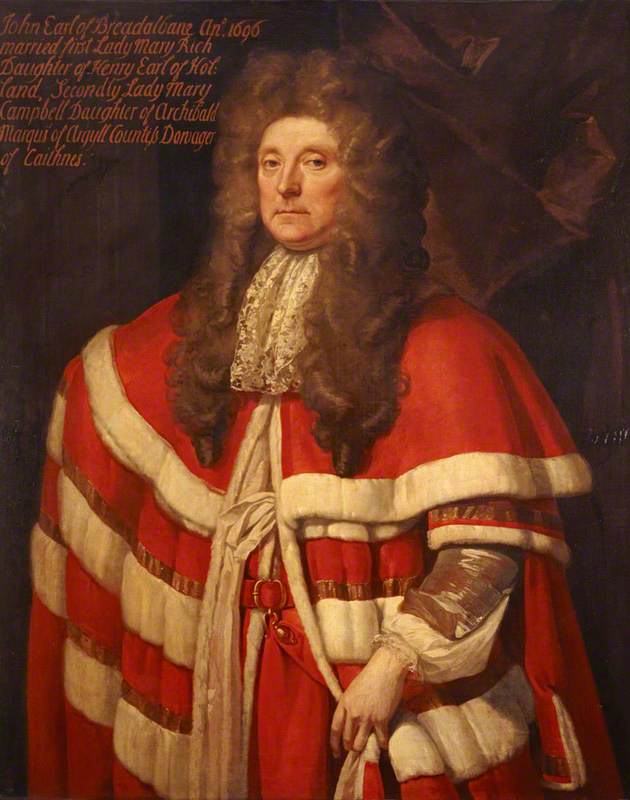
Portrait: John Baptist Medina / Wikimedia Commons / Public domain John Campbell, Earl of Breadalbane
Held negotiations with Highland chiefs in the ruined castle in 1691.
Connections
-
Loch Tulla
The castle stands near the north end of the loch.
-
Bridge of Orchy
The ruin lies north of this Highland settlement.
-
Glencoe
The 1691 negotiations at Achallader formed part of the fraught political background before the massacre.
What to look for
-
Surviving walls
Two walls remain from the former tower house.
-
Corbelling trace
One wall keeps a trace of corbelled masonry.
-
Shot-holes
The tower house was defended with openings for firearms.
What is said
Folklore and tradition, recorded as what is said — not as established fact.
-
The Fletcher story
A local story says Black Duncan Campbell used a dispute over a horse in the Fletchers' corn to gain control of the property after advising the Fletcher laird to flee to France. (tradition)
Plan your visit
- Location
- 56.5599°N · 4.7316°W
- Terrain
- Rough ground — reasonable boots advised
Opening & admission
Check locally before travelling
- The source describes the remains sheltering Achallader Farm buildings but gives no public access details.
- Treat access as uncertain and avoid assuming entry onto farm ground.
Nearby places
Questions people ask
- What is Achallader Castle?
- It is a ruined 16th-century tower house below Beinn Achaladair, near the north end of Loch Tulla.
- Why is Achallader Castle historically important?
- It is linked to Campbell expansion, MacGregor burning in 1603, and Highland negotiations led by the Earl of Breadalbane in 1691.
- What survives at Achallader Castle?
- Two walls survive, including a trace of corbelling, from a tower house that once had three storeys and a garret.
- Is the Fletcher story certain history?
- The story is presented as tradition rather than a secure documentary account.
Sources
Explore more: Building or ruins · Medieval · Argyll and Bute
The Ancient Codex, in your pocket
Get the Pocket Codex app
Carry the directory with you — Achallader Castle and thousands of ancient places across Britain and Ireland, offline, wherever you roam.