
One of the oldest stone castles in Scotland, Dunstaffnage was raised in the second quarter of the 13th century by the MacDougall lords of Lorn and belongs to a small local group that also includes Castle Sween and Castle Tioram. Its name joins Gaelic dun, “fort”, to the Norse stafa nes, “headland of the staves”, a fitting label for a stronghold set on a platform of conglomerate rock at the south-west entrance to Loch Etive, about 3 miles north-north-east of Oban.
Built to guard the seaway into Loch Etive and the Pass of Brander beyond, the castle passed to Clan Campbell in the 15th century and has been held by them since. A hereditary Captain of Dunstaffnage still carries the office, though the family no longer lives within the walls. The castle and its ruined chapel entered state care in 1958 and are maintained by Historic Environment Scotland, with the 16th-century gatehouse retained as the Captain’s private property.
What follows is drawn from published sources, with each claim labelled by how firmly it is established.
The name
The prefix dun means "fort" in Gaelic, while the remainder of the name derives from the Norse stafa nes, "headland of the staves". The Gaelic form is Caisteal Dhùn Stadhainis.
History
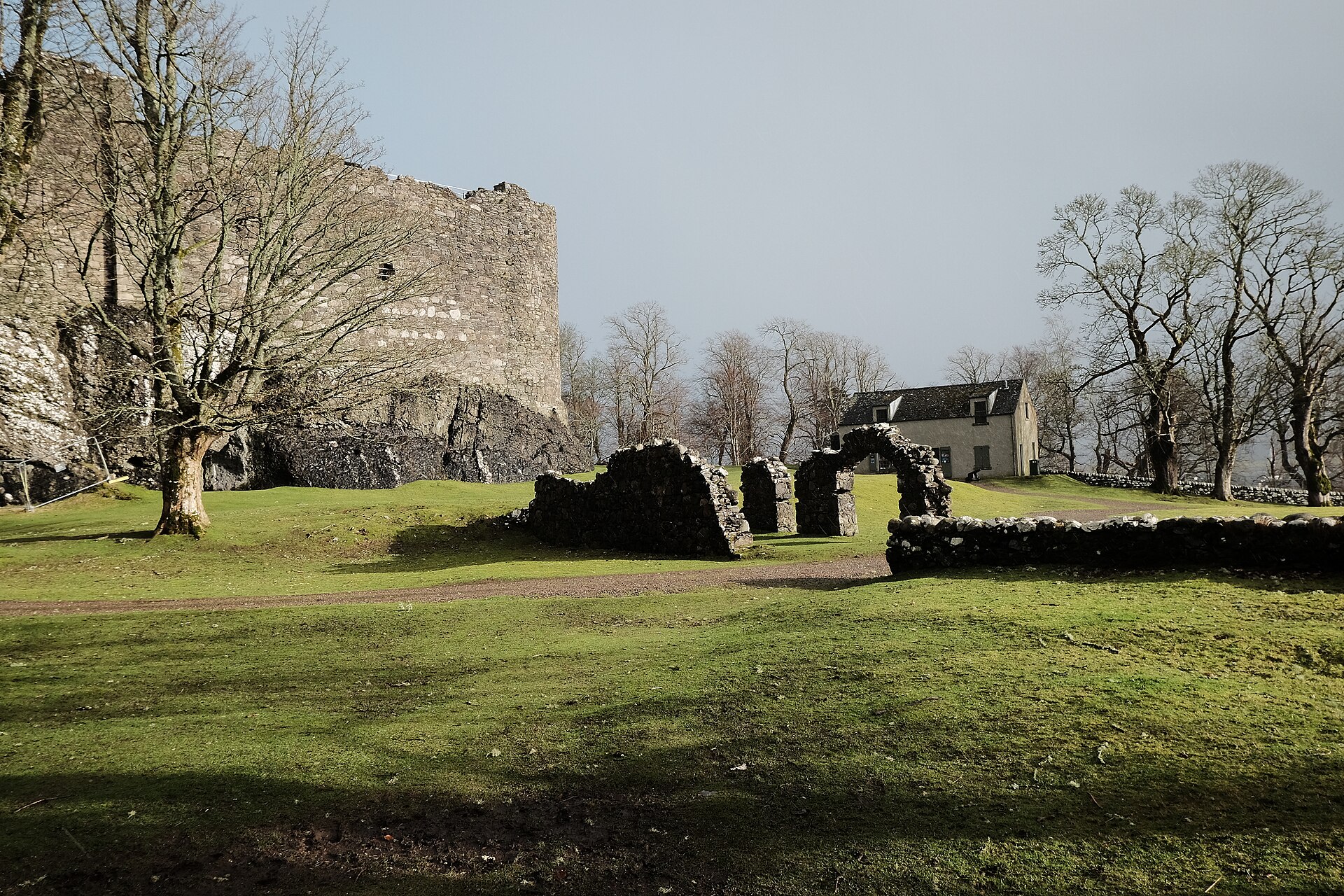
In the second quarter of the 13th century the castle became the seat of Duncan MacDougall, Lord of Lorn and grandson of Somerled; Duncan had travelled to Rome in 1237 and founded nearby Ardchattan Priory. Ewen MacDougall, inheriting his father's title in the 1240s, is thought to have added the three round towers and enlarged the hall while styling himself "King of the Isles".
After defeating the MacDougalls at the Battle of the Pass of Brander in August 1308, Robert Bruce took Dunstaffnage following a brief siege. He did not destroy it but appointed a constable and provisioned it to guard the countryside and seaways. James I seized the castle in 1431 following the Battle of Inverlochy, as his enemies were hiding inside.
In 1455 James Douglas, 9th Earl of Douglas, stayed at Dunstaffnage on his way to treat with John MacDonald, Lord of the Isles, a meeting that led to the Treaty of Westminster-Ardtornish. In 1463 the keeper John Stewart of Lorn was stabbed by supporters of Alan MacDougall on his way to his marriage at Dunstaffnage Chapel, but lived long enough to make his vows.
In 1470 James III granted Dunstaffnage to Colin Campbell, 1st Earl of Argyll, after ousting Alan MacDougall, beginning Campbell control of the castle. During the Civil War the castle held out against Montrose's army in 1644, and was later burned by royalist troops following the failure of Argyll's Rising in 1685.
An accidental fire gutted the gatehouse in 1810, after which the Captains ceased to live at the castle and moved to Dunstaffnage House about 2 km to the south-east. In 1958 the 21st Captain and the Duke of Argyll agreed to hand the castle into state care.
People
-
Duncan MacDougall, Lord of Lorn
Grandson of Somerled who made Dunstaffnage his seat in the 13th century and also built the nearby chapel.
-
Ewen MacDougall
Duncan's son, who probably built the three round towers and enlarged the hall, styling himself "King of the Isles".
-
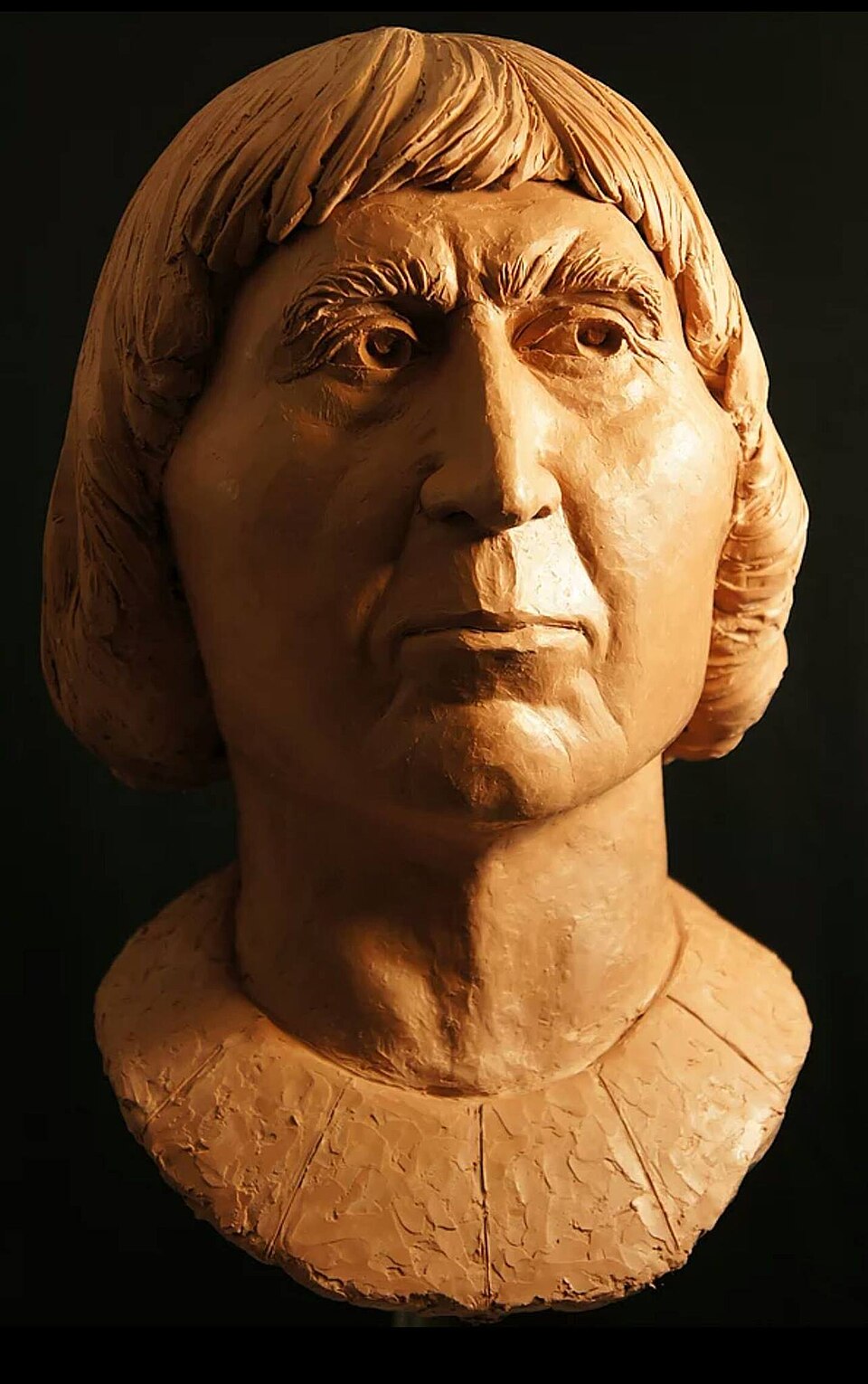
Portrait: S.A.Farabi / Wikimedia Commons / CC BY-SA 4.0 Robert Bruce
King of Scots who captured the castle after the Battle of the Pass of Brander in 1308 and provisioned it as a royal stronghold.
-
Colin Campbell, 1st Earl of Argyll
Granted Dunstaffnage by James III in 1470, beginning Clan Campbell's long tenure.
-
Flora MacDonald
Helper of Bonnie Prince Charlie's escape, briefly imprisoned at Dunstaffnage while en route to imprisonment in London.
-
Aeneas Campbell, 11th Captain, and Dame Lilias
Commemorated by the initials AEC and DLC on the gatehouse dormer pediments.
Cultural influences
-
Masonry castle of the western seaboard
Dating to the 13th century, Dunstaffnage belongs to a small local group of early stone castles alongside Castle Sween and Castle Tioram, illustrating the masonry castle-building of Scotland's western seaboard.
-
A hereditary captaincy kept alive by ritual
The office of Hereditary Captain of Dunstaffnage survives as a sinecure without military significance; to keep the title, the incumbent must spend three nights a year in the castle, and no other duties or privileges attach to the post.
Connections
-
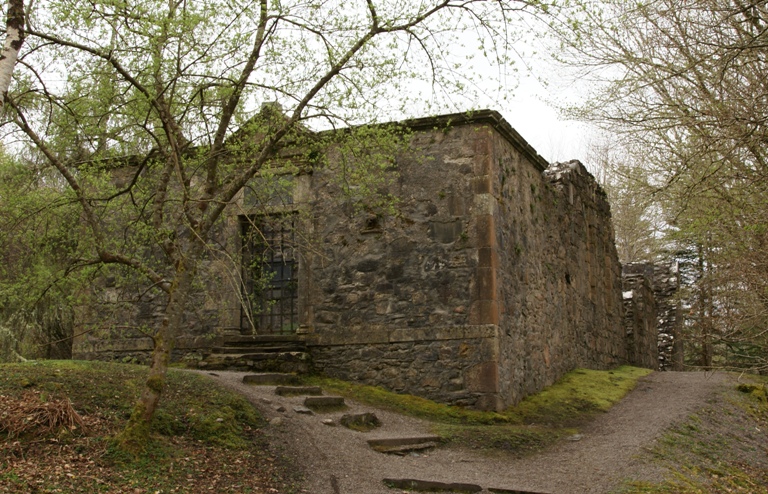
Photo: Otter / Wikimedia Commons / CC BY-SA 3.0 Dunstaffnage Chapel
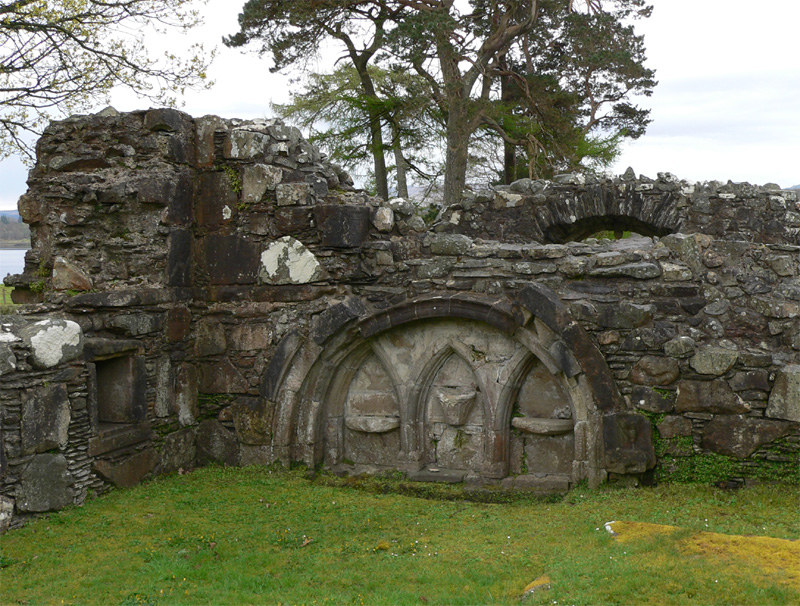
Ruined private chapel about 150 metres to the south-west, also built by Duncan MacDougall of Lorn and later given a Campbell burial aisle.
-
Castle Sween and Castle Tioram
Part of the same local group of early 13th-century stone castles.
-
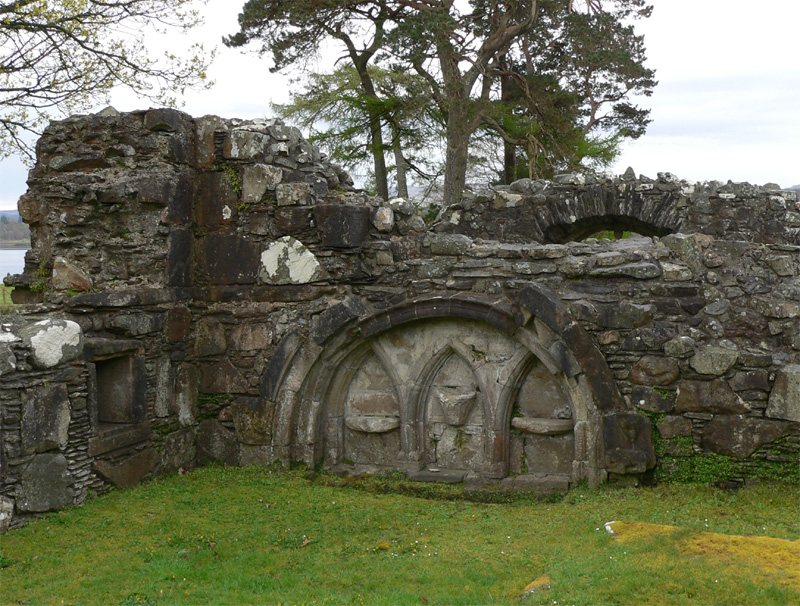
Photo: Otter / Wikimedia Commons / CC BY-SA 3.0 Ardchattan Priory
Founded nearby by Duncan MacDougall, lord of the castle.
-
MacDonald Lords of the Isles
Target of government expeditions based at Dunstaffnage under the Earls of Argyll during the 15th and 16th centuries.
In culture
-
A veiled appearance in Humphry Clinker
According to W. Douglas Simpson, the castle appears in Tobias Smollett's Humphry Clinker (1771) which, though not naming Dunstaffnage, presents a fair picture of life in the castle in the third quarter of the eighteenth century.
What to look for
-
Curtain walls and gunloops
The irregular quadrangle measures roughly 35 by 30 metres with a circumference near 120 metres; its coursed rubble walls, up to 3 metres thick and 18 metres high including the bedrock, retain arrow slits later converted into gunloops as their only openings. Brass cannon salvaged from wrecked Spanish Armada vessels were once mounted here.
-
The north tower (donjon)
The largest of the three round towers, originally three or four storeys, which probably housed the lord's private apartments.
-
The west tower pit prison
The almost-internal west tower, entered only from the parapet walk, has a basement pit prison accessed from above.
-
The gatehouse and its pediments
The four-storey harled gatehouse carries dormer pediments moved from the 1725 house, bearing the Campbell arms and the initials AEC and DLC for Aeneas Campbell, 11th Captain, and his wife Dame Lilias.
-
Blocked hall windows
The outlines of blocked double-lancet hall windows, once decorated with carved patterns, can be seen in the east curtain wall where the vanished east range once held the great hall.
-
Dunstaffnage Chapel
The ruined chapel to the south-west, with dog-tooth carving on its lancet windows and wide-splayed internal arches, plus an 18th-century Campbell burial aisle.
What is said
Folklore and tradition, recorded as what is said — not as established fact.
-
The Ell-maid of Dunstaffnage
A ghost known as the "Ell-maid of Dunstaffnage", a type of gruagach, is said to haunt the castle, its appearances associated with events in the lives of the hereditary keepers. (local tradition)
-
The Stone of Destiny
It is said, on a 1612 record by John Monipennie, that the Stone of Destiny was kept at Dunstaffnage after being brought from Ireland and before its move to Scone in 843; Hector Boece placed the stone at "Evonium", traditionally identified with the site, though Iona and Dunadd are considered more likely. (disputed tradition)
-
Dun Monaidh
Before the castle was built, Dunstaffnage may have been the site of a Dal Riatan stronghold known as Dun Monaidh, possibly as early as the 7th century. (unverified)
Plan your visit
- Location
- 56.4547°N · 5.4369°W
Nearby places
Questions people ask
- Who built Dunstaffnage Castle?
- It was built by the MacDougall lords of Lorn, becoming the seat of Duncan MacDougall in the second quarter of the 13th century, with his son Ewen probably adding the three round towers.
- What does the name Dunstaffnage mean?
- The Gaelic prefix dun means "fort", while the rest of the name derives from the Norse stafa nes, "headland of the staves".
- How did the castle pass to Clan Campbell?
- After Robert Bruce took it from the MacDougalls in 1308 it became Crown property; James III granted it to Colin Campbell, 1st Earl of Argyll, in 1470, and the Campbells have held it since.
- Is there really a Captain who must sleep in the castle?
- Yes. The Hereditary Captain of Dunstaffnage still holds the title and, to retain it, must spend three nights a year in the castle, though the role now carries no other duties.
- Who is said to haunt Dunstaffnage?
- Tradition tells of the "Ell-maid of Dunstaffnage", a type of gruagach whose appearances are said to be tied to events in the lives of the hereditary keepers.
Sources
- Wikipedia: Dunstaffnage Castle (accessed 2026-07-18)
- Wikidata: Dunstaffnage Castle (Q178522) (accessed 2026-07-18)
- Historic Environment Scotland: Dunstaffnage Castle (SM90120) (accessed 2026-07-18)
- Canmore: Dunstaffnage Castle (accessed 2026-07-18)
Explore more: Building or ruins · Medieval · Argyll and Bute
The Ancient Codex, in your pocket
Get the Pocket Codex app
Carry the directory with you — Dunstaffnage Castle and thousands of ancient places across Britain and Ireland, offline, wherever you roam.