
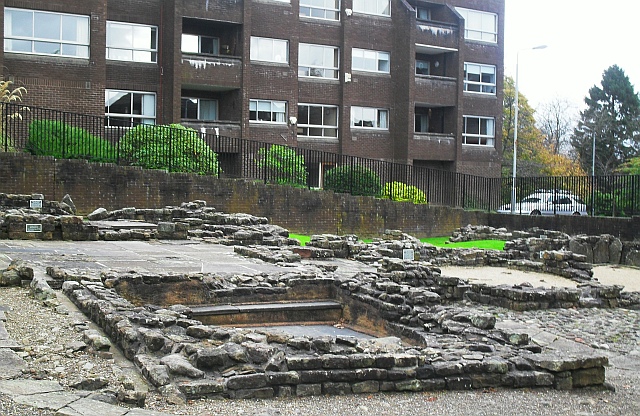
Bath-house walls near Bearsden town centre preserve one of the clearest Roman survivals in the suburb. Bearsden Roman fort was a Roman fort (a military base) on the Antonine Wall, with a nearby bath house now protected and visible.
The wider pack is about the modern town, but its Roman section is strong: the fort stood where the Military Way met a north-south route, and the bath-house remains were discovered during modern building work before being saved for the public.
What follows is drawn from published sources, with each claim labelled by how firmly it is established.
History
A Roman fort occupied the area of present-day Bearsden in the second century AD.
Between 142 and 144 AD, Roman forces under Antoninus Pius built the Antonine Wall and its Military Way across central Scotland.
The Bearsden fort stood at the intersection of the Military Way and a north-south route between Glasgow and Loch Lomond.
The Romans withdrew to Hadrian's Wall in 164 AD, after only a short occupation.
Builders discovered the bath-house remains in 1973 while digging foundations for housing.
The bath-house site was donated to the nation and now survives close to Bearsden town centre.
People
-

Portrait: Unknown artistUnknown artist / Wikimedia Commons / Public domain Antoninus Pius
Emperor associated with the construction of the Antonine Wall.
-
Modern builders
Discovered the bath-house remains during foundation work in 1973.
Cultural influences
-
Visible Roman bathing
The bath-house remains offer a rare above-ground visitor focus for the local Roman frontier.
-
Route crossing
The fort's position at a road junction helps explain its strategic role.
Connections
-
Antonine Wall
The frontier line runs through Bearsden.
-
New Kilpatrick Cemetery
Two stretches of the Wall's stone base can be seen there.
-
Military Way
Roman road running parallel to the Wall.
Discovery & excavation
The bath house was found in 1973 by builders during housing development. The remains were preserved and donated to the nation.
In culture
-
Video reconstruction
A reconstruction of the Bearsden Roman site has been produced.
What to look for
-
Bath-house remains
The preserved walls lie close to the town centre.
-
Wall base
Additional stretches of Antonine Wall base are visible in New Kilpatrick Cemetery.
-
Town setting
The Roman remains sit within a modern Glasgow suburb.
Plan your visit
- Location
- 55.9193°N · 4.3291°W
- Access
- Open access
- Terrain
- Easy going
Opening & admission
The pack says the bath-house remains were donated to the nation and can be seen near the town centre; check current site information before travelling.
- The bath house was discovered in 1973.
- Two stretches of Wall base can be seen in New Kilpatrick Cemetery.
Nearby places
Fortified place · Roman
Bearsden Roman Bath House
East Dunbartonshire
The Romans built a stone-and-turf fortification, the Antonine Wall, between the Firth of Clyde and the Firth of Forth between AD 142 and 144 under…
- Near Bearsden
- 3 min walk from car park
Questions people ask
- What Roman remains can be seen at Bearsden?
- The pack says the remains of a Roman bath house can be seen near the town centre.
- When was the bath house discovered?
- It was discovered in 1973 by builders digging foundations for housing.
- Why was the fort placed at Bearsden?
- It stood where the Military Way met a north-south route between Glasgow and Loch Lomond.
- When did the Romans leave Bearsden?
- The pack says the Romans withdrew to Hadrian's Wall in 164 AD.
- Are other Antonine Wall remains nearby?
- Yes. Two stretches of the Wall's stone base can be seen in New Kilpatrick Cemetery.
Sources
Explore more: Fortified places · Roman · East Dunbartonshire
The Ancient Codex, in your pocket
Get the Pocket Codex app
Carry the directory with you — Bearsden Roman fort and thousands of ancient places across Britain and Ireland, offline, wherever you roam.