
The stones were carved during the height of Pictish power in Angus, part of the kingdom later remembered as Fortriu. The Class I symbol stones carry the older incised-symbol tradition; the Class II cross-slabs mark the period when Pictish art fused with Christianity.
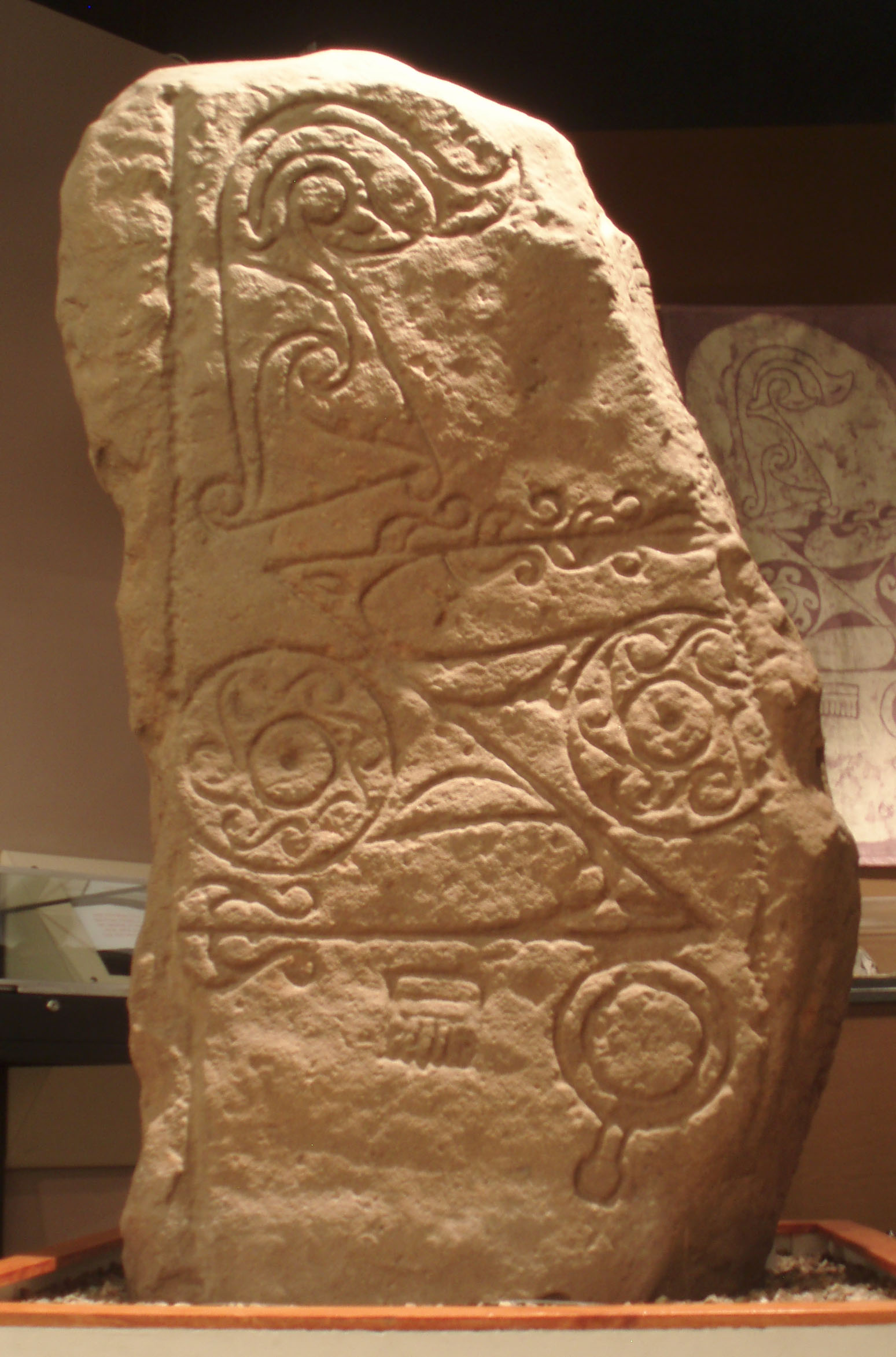
A serpent, a double-disc-and-Z-rod, and a mirror-and-comb are cut deep into weathered sandstone at Aberlemno — Pictish symbols whose meaning is not recorded in any source used here. On a second stone a few hundred yards south, three carved registers of riders and foot-soldiers are read as a battle scene, a raven picking at a fallen warrior in the lowest band. A third slab carries a ringed cross wrapped in interlace on one face, and older symbols on the other.
These are the Aberlemno Sculptured Stones, a group of Pictish carved stones standing in and around the village of Aberlemno, Angus.
What we know
Two carving traditions sit side by side here. The Class I stones carry the older, incised Pictish symbol system — serpent, double-disc-and-Z-rod, mirror-and-comb — a set of signs whose meaning is not recorded in any source used for this page. The Class II cross-slabs come later: a ringed cross wrapped in interlace and knotwork on one face, Pictish symbols retained on the other, marking the point where Pictish art absorbed Christian forms rather than replacing what came before. Carving on the group runs broadly from the sixth to the ninth century CE, with the cross-slabs re-dated more recently to somewhere between the mid-eighth and mid-ninth century.
One stone carries an older layer still. The roadside stone bearing the serpent and mirror-and-comb symbols shows prehistoric cup marks on its reverse face — evidence that the Picts reused a standing stone already centuries old when they carved it.
The three-register battle scene on the reverse of the kirkyard cross-slab is among the most reproduced images in Pictish studies. Historian Graeme Cruickshank argued in 1985 that it depicts the Battle of Dun Nechtain, fought in AD 685 some five kilometres south near Dunnichen, where Pictish forces defeated a Northumbrian army. The argument gained wide acceptance, though the stone’s later re-dating to the mid-ninth century complicates a direct memorial link to that specific battle.
Two further stones from the group stand outside the village. A fourth stone — the Flemington Farm Stone — was found in the early 1960s and is now displayed in The McManus, Dundee. A fifth, the Woodwrae Stone, was reused as a floor slab in a nearby ruined castle before being removed in 1819 to Walter Scott’s collection at Abbotsford; it was donated to the Society of Antiquaries of Scotland in 1924 and now stands in the National Museum of Scotland. A further Class I stone was found as recently as 2022, by a University of Aberdeen team led by archaeologist Gordon Noble.
What is said
A sixteenth-century chronicler, Hector Boece, once claimed the battle scene marked a Pictish slaughter of Danish raiders near Aberlemno — the so-called Battle of Barry — though the claim is now regarded as historically unfounded. Other readings of the battle scene are thought less certain still: a Pict–Viking encounter, a memorial to the eighth-century king Óengus I, or an allegory of spiritual struggle.
What to see now
Three stones stand in or near their original positions in the village today; the roadside cross slab is currently removed for conservation work, so it will not be visible at every visit. On the northern roadside stone, the serpent, double-disc-and-Z-rod, and mirror-and-comb symbols are still boldly incised, with the older cup marks visible on the reverse for those who look closely. In the kirkyard, some three hundred yards south, the tall cross-slab carries the battle scene on its rear face and a ringed, interlaced cross on the front. A third roadside stone, slimmer and taller, shows adoring angels flanking its cross and a hunting scene below Pictish symbols on the reverse. A fifth stone, closer to the centre of the village, carries only faint traces of carving, thought either unfinished or a later imitation.
The carvings are weathering, and for that reason the outdoor stones are boxed in timber covers from the last working day of September until the first working day of April each year. They can only be seen, unboxed, roughly between April and late September.
How to visit
The stones stand in and around the village of Aberlemno, Angus, in eastern Scotland; individual stone positions are not given here. Entry is free. Because of the seasonal boxing described above, an April-to-September visit gives the best chance of seeing every outdoor stone uncovered. Historic Environment Scotland’s official pages carry current opening notes and getting-here guidance for anyone planning ahead.
What follows is drawn from published sources, with each claim labelled by how firmly it is established.
The name
Aberlemno combines the Pictish/Brittonic 'aber' (river mouth or confluence) with the Lemno burn — 'mouth of the Lemno'. The 'aber-' prefix is itself a marker of Pictish-era place-naming in eastern Scotland.
History
The stones were carved during the height of Pictish power in Angus, part of the kingdom later remembered as Fortriu. The Class I symbol stones carry the older incised-symbol tradition; the Class II cross-slabs mark the period when Pictish art fused with Christianity.
The battle scene on the reverse of Aberlemno 2 is widely interpreted as a depiction of the Battle of Dun Nechtain (Nechtansmere, AD 685), the Pictish victory over the Northumbrians under Ecgfrith, fought roughly 5 km south near Dunnichen. The interpretation (Graeme Cruickshank, 1985) gained broad acceptance, though the stone's re-dating to the mid-9th century has since complicated a direct memorial link.
Alternative readings of the battle scene include a Pict–Viking encounter, a memorial to the 8th-century Pictish king Óengus I, or an allegory of spiritual struggle.
People
-
The Picts
Carvers and the culture that raised the stones
-
King Óengus I (Onuist)
8th-century Pictish king; one candidate the battle-scene may memorialise
-
Graeme Cruickshank
Historian whose 1985 work linked Aberlemno 2 to the Battle of Dun Nechtain
-
Gordon Noble (University of Aberdeen)
Archaeologist who led the team that found a further Class I stone in 2022
-
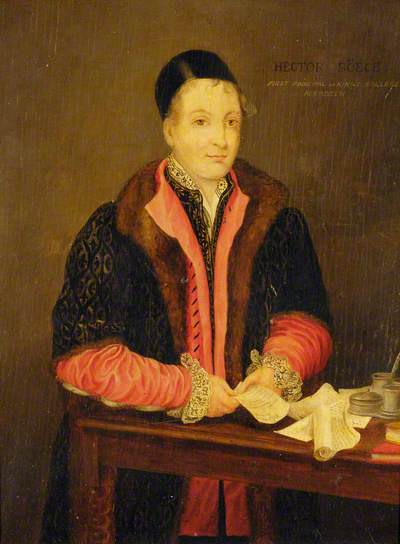
Portrait: Unknown artistUnknown artist / Wikimedia Commons / Public domain Hector Boece
16th-century chronicler who first recorded the stone, tying it to the (now discredited) Battle of Barry
Cultural influences
-
Pictish symbol tradition — serpent, double-disc-and-Z-rod, mirror-and-comb, crescent-and-V-rod — whose meaning remains unknown.
-
Early Christian Scotland — the Class II cross-slabs carry a ringed Celtic cross with knotwork, keywork and interlace on one face and Pictish symbols on the other, showing the fusion rather than replacement of the two traditions.
-
Insular / Northumbrian art — the zoomorphic and interlace designs on Aberlemno 2 are compared to the Book of Kells and Northumbrian work; Aberlemno 3's hunting scene parallels the Hilton of Cadboll stone in Easter Ross.
Connections
-
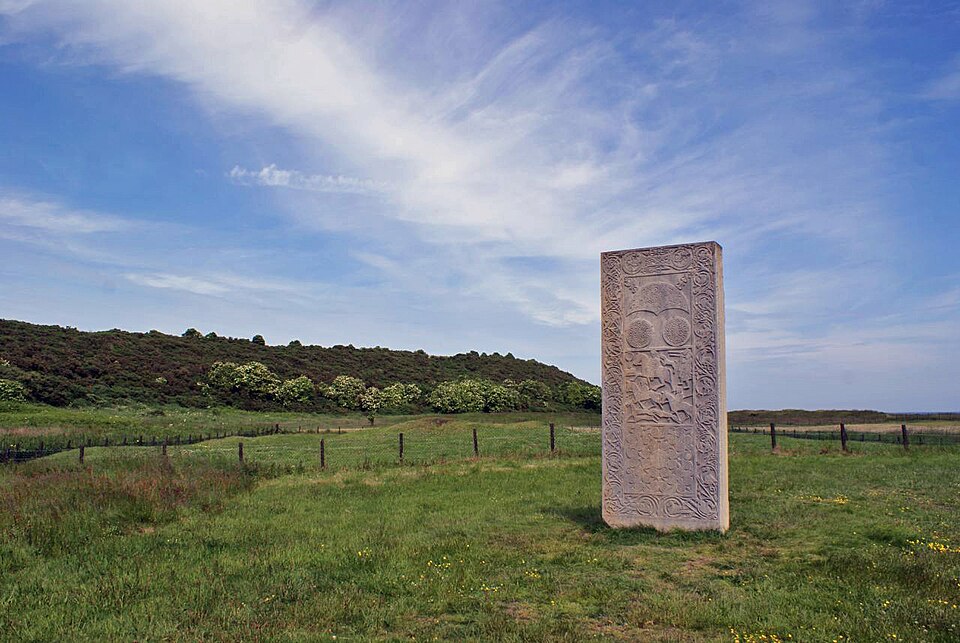
Photo: Richard Dorrell / Wikimedia Commons / CC BY-SA 2.0 Hilton of Cadboll stone
Closest artistic parallel (hunting scene); now in the Museum of Scotland
-
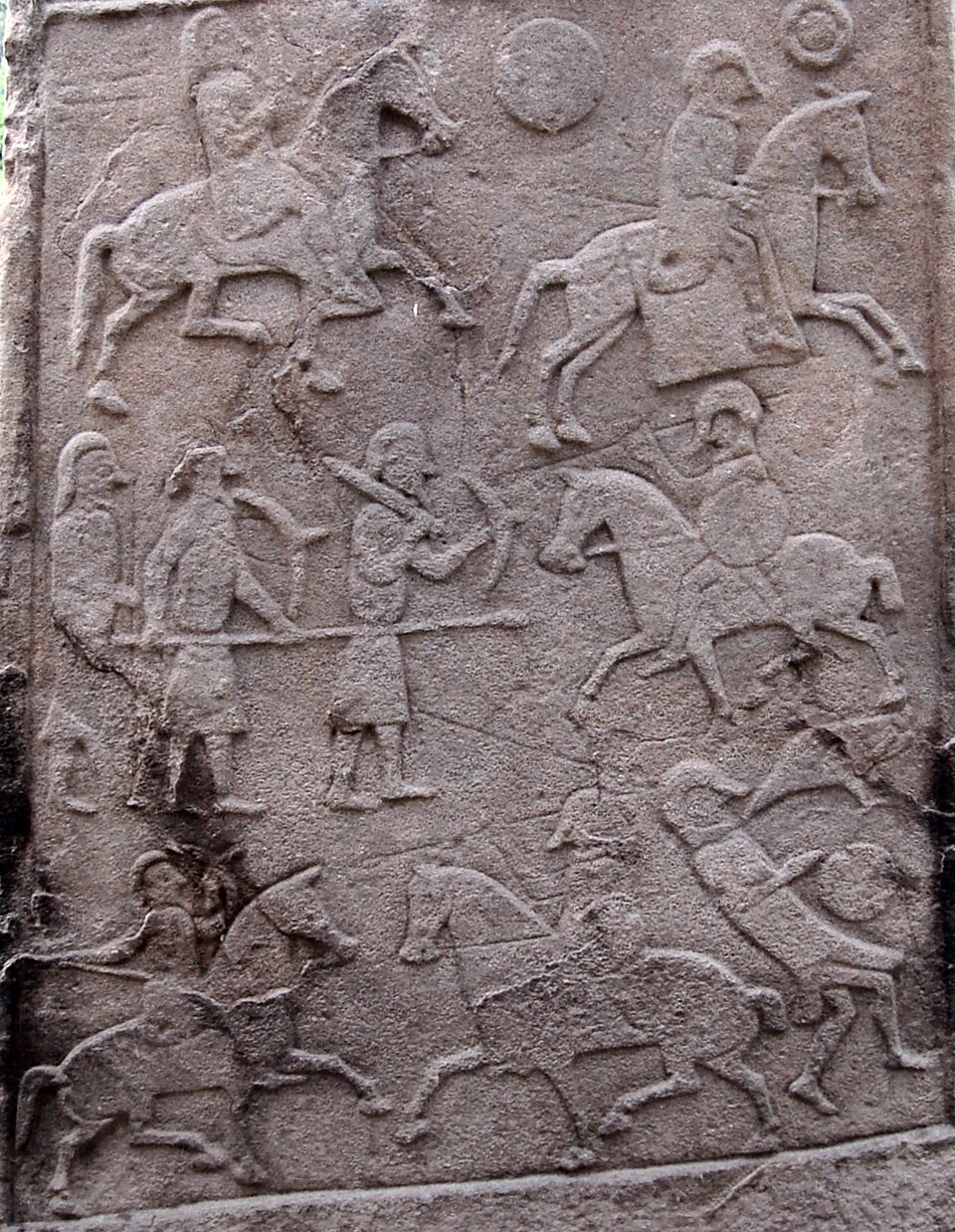
Photo: Greenshed / Wikimedia Commons / Public domain Battle of Dun Nechtain / Dunnichen
Battle site ~5 km south, linked to the Aberlemno 2 battle scene
-
The McManus, Dundee
Holds Aberlemno 4 (Flemington Farm Stone)
-
National Museum of Scotland, Edinburgh
Holds the related Woodwrae Stone (from a ruined castle 1 km north)
-
Brechin
Nearest historic burgh (~4 miles); reference point in early accounts
Discovery & excavation
Aberlemno 4 (the Flemington Farm Stone) was found in 1961 and is now displayed in The McManus, Dundee. The Woodwrae Stone, reused as a floor slab in a nearby ruined castle, was removed in 1819 to Sir Walter Scott's collection at Abbotsford and donated to the Society of Antiquaries of Scotland in 1924 (now in the National Museum of Scotland). A further Class I stone was discovered in 2022 by a team led by Gordon Noble of the University of Aberdeen.
Finds now held at: The McManus, Dundee (Aberlemno 4); National Museum of Scotland (Woodwrae Stone).
In culture
-
A touchstone of Pictish-art scholarship since the 19th century (J. Romilly Allen and Joseph Anderson's classification); the battle scene is among the most reproduced images in Scottish early-medieval studies.
What to look for
-
Aberlemno 1 (northern roadside): boldly incised serpent, double-disc-and-Z-rod and mirror-and-comb on one face; prehistoric cup marks on the reverse betray its reuse.
-
Aberlemno 2 (kirkyard, ~300 yards south): a 2.3 m Old Red Sandstone cross-slab — ringed Celtic cross on the west face, and on the rear the famous three-register battle scene.
-
Aberlemno 3 (western roadside): a tall, slim cross-slab with adoring angels flanking the cross and a hunting scene below Pictish symbols on the reverse.
-
Aberlemno 5 (central roadside): only faint traces of carving — thought unfinished or a later imitation.
What is said
Folklore and tradition, recorded as what is said — not as established fact.
-
According to the 16th-century chronicler Hector Boece, the stone once marked the slaughter of a Danish company near Aberlemno — the 'Battle of Barry' — a claim now regarded as historically inauthentic. (now known to be historically inauthentic)
-
16th-century chronicler Hector Boece recorded that the stone marked the slaughter of a Danish company near Aberlemno (the 'Battle of Barry'). (now known as a tradition/chronicle claim rather than verified battle history)
Plan your visit
- Location
- General area near Aberlemno, Angus
- Nearest settlement
- Aberlemno
- Access
- Visible from a public way
- Terrain
- Easy going
- Best time
- The outdoor stones are covered with protective wooden boxes from the last working day of September until the first working day of April — they can only be seen between roughly April and late September.
- What survives
- Three stones remain in or near their original positions in the village; two further stones are in museums. The carvings are weathering, which is why the outdoor stones are now seasonally boxed.
- Start point
- Aberlemno roadside parking (B9134, Aberlemno village) — The stones stand beside the B9134 and in Aberlemno churchyard; roadside parking is available by the village. A public amenity only — not the exact monument location, which is treated as approximate.
Opening & admission
Free entry
- The Aberlemno Sculptured Stones are free to visit.
- The Roadside Cross Slab has been removed for conservation work.
- Because the stones are vulnerable to frost damage and cold winter conditions, they’re covered with wooden boxes from the last working day of September until the first working day of April.
- Please note, the stones are covered with wooden boxes from the end of September until early April for their protection against the elements.
This is a sensitive site, so we show its general area only. Please use the official access information here rather than seeking out an independent route.
Nearby places
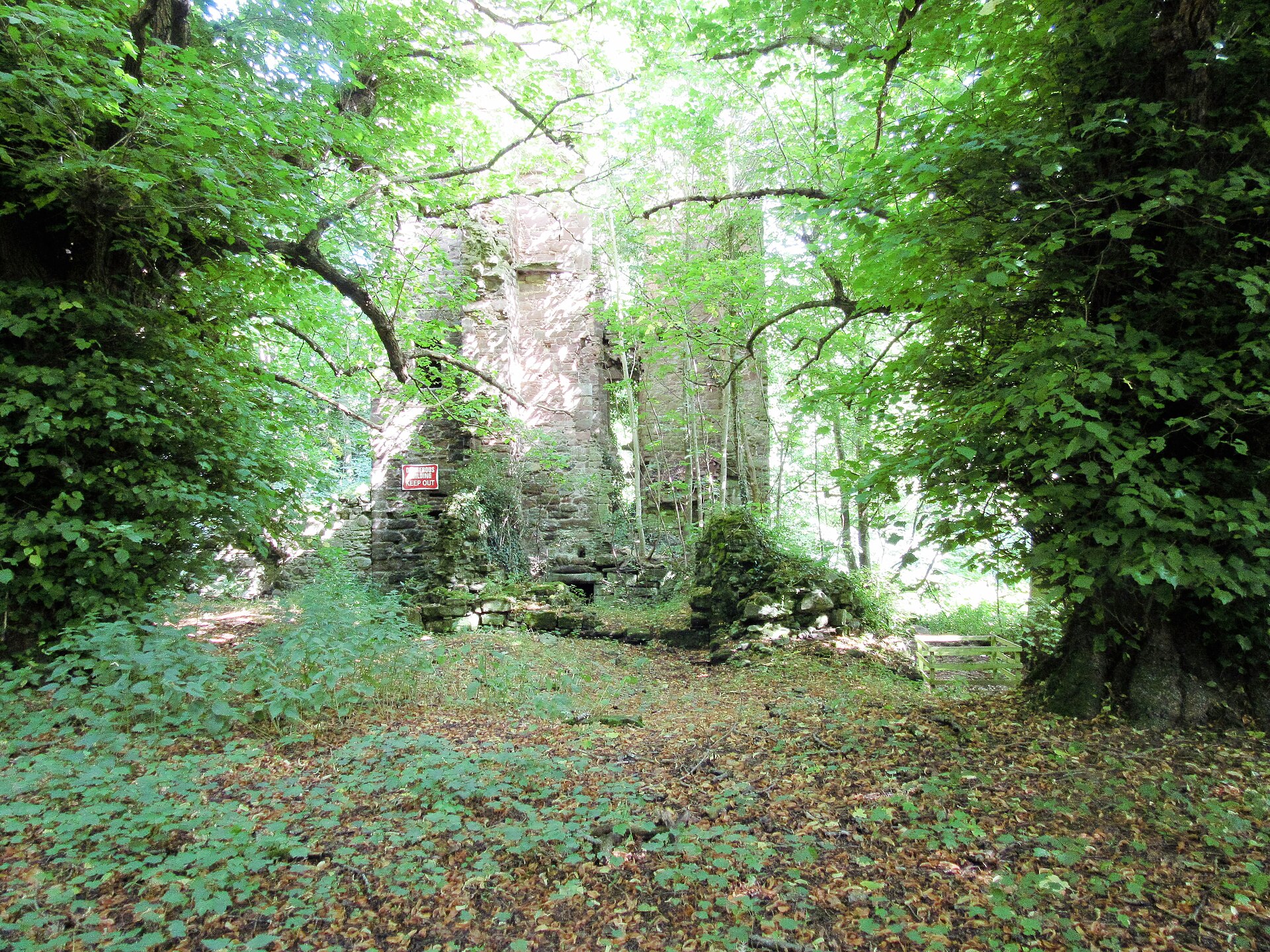
Fortified place · Medieval
Finavon Castle
Angus
It preserves the seat of the Lindsay Earls of Crawford, among medieval Angus's foremost noble families, from their rise in 1375 to the loss of the…
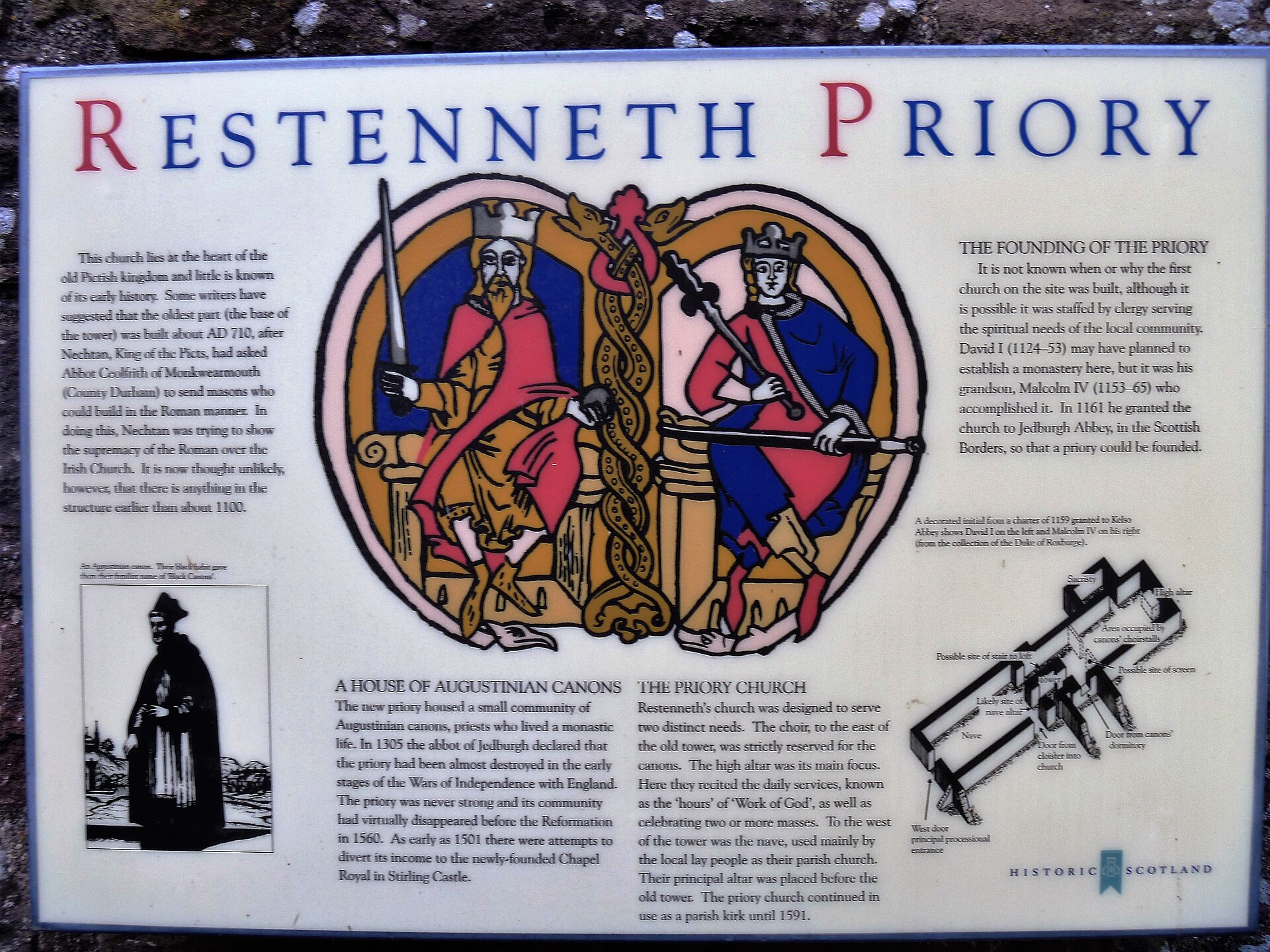
Building or ruin · Pictish & early medieval
Restenneth Priory
Angus
Restenneth Priory was a monastic house of Augustinian canons founded by Jedburgh Abbey, under the patronage of King Malcolm IV of Scotland, in 1153…
- Near Forfar
- 3 min walk from car park
Questions people ask
- How old are the Aberlemno stones?
- Carving runs broadly from the sixth to the ninth century CE; the two cross-slabs are dated more precisely to between the mid-eighth and mid-ninth century.
- What do the carved symbols mean?
- Unknown. The serpent, double-disc-and-Z-rod, and mirror-and-comb belong to the wider Pictish symbol system, but no source used here records what the individual signs meant.
- Can the Aberlemno stones be visited?
- Yes, free of charge, though the outdoor stones are boxed for protection each winter and can only be seen roughly between April and late September.
- Who built the Aberlemno stones?
- The Picts, during the height of their power in Angus, part of the kingdom later remembered as Fortriu; no individual carver's name survives in the sources used here.
- What survives of the Aberlemno stones today?
- Three stones stand in or near their original positions in Aberlemno village; two others — the Flemington Farm Stone and the Woodwrae Stone — are held in museums in Dundee and Edinburgh.
Sources
- Canmore site record 34860 (accessed 2026-07-09)
- Trove (HES) record (accessed 2026-07-09)
- Wikipedia: Aberlemno sculptured stones (accessed 2026-07-09)
- Wikidata Q2293146 (accessed 2026-07-09)
- Historic Environment Scotland: Aberlemno Sculptured Stones (accessed 2026-07-09)
Explore more: Carved stones · Pictish & early medieval · Angus
The Ancient Codex, in your pocket
Get the Pocket Codex app
Carry the directory with you — Aberlemno Sculptured Stones and thousands of ancient places across Britain and Ireland, offline, wherever you roam.