
A late-16th-century Borders fortified house whose Italianate terraced gardens, laid out after the Union of the Crowns, were counted among the grandest in Scotland.
Elibank Castle stands as a ruined fortified house above the south bank of the River Tweed, roughly three kilometres east of Walkerburn in the Scottish Borders. Its documented story begins in 1511, when James IV granted a charter to Catherine Douglas and her son John Liddle to bring farmland at “Aleburn or Eliburn” into use, requiring them to raise a stone house, barn, doocot and cattle sheds. The estate passed from the Liddale family to Gideon Murray in 1594, and it was Murray — depute-treasurer of Scotland — who built the surviving castle around 1595. Following the fashion that took hold among Scottish courtiers after the Union of the Crowns in 1603, Murray laid out an Italianate arrangement of terraces on three sides of the building; these garden works were reckoned among the grandest in the country. The property later carried its title through a succession of Lords Elibank. By 1722 the house had fallen into ruin, and its remains are now protected as a scheduled monument. What survives speaks less of border warfare than of a courtier’s ambition to shape both a fortified home and an ornamental landscape in a settled age.
What follows is drawn from published sources, with each claim labelled by how firmly it is established.
What to look for
-
The ruined shell of a fortified house built around 1595 by Gideon Murray, depute-treasurer of Scotland
-
Traces of the Italianate terraces once set on three sides of the castle
-
Its elevated setting above the south bank of the River Tweed, near the A72 east of Walkerburn
-
Its protected status as a scheduled monument, the house having stood ruinous since 1722
Plan your visit
- Location
- General area near Scottish Borders, Scottish Borders
This is a sensitive or fragile site, so we show only its general area. Please check official heritage sources for access before visiting, and take care not to disturb it.
Nearby places
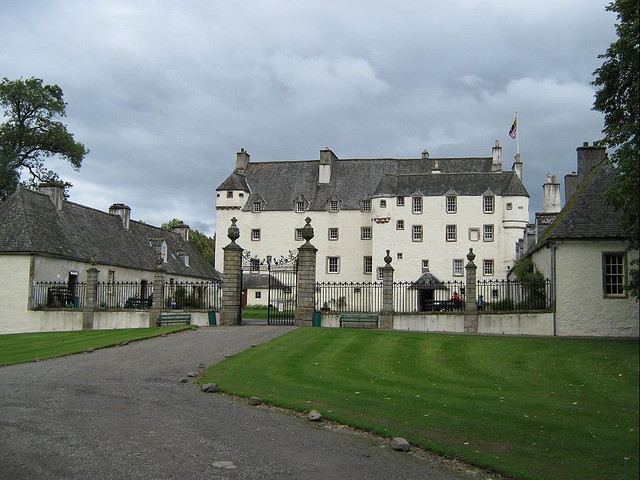
Fortified place · Medieval
Traquair House
Scottish Borders
Claimed to be the oldest continually inhabited house in Scotland, its walls trace an unbroken line from a medieval royal hunting seat through the S…
The Ancient Codex, in your pocket
Get the Pocket Codex app
Carry the directory with you — Elibank Castle and thousands of ancient places across Britain and Ireland, offline, wherever you roam.