
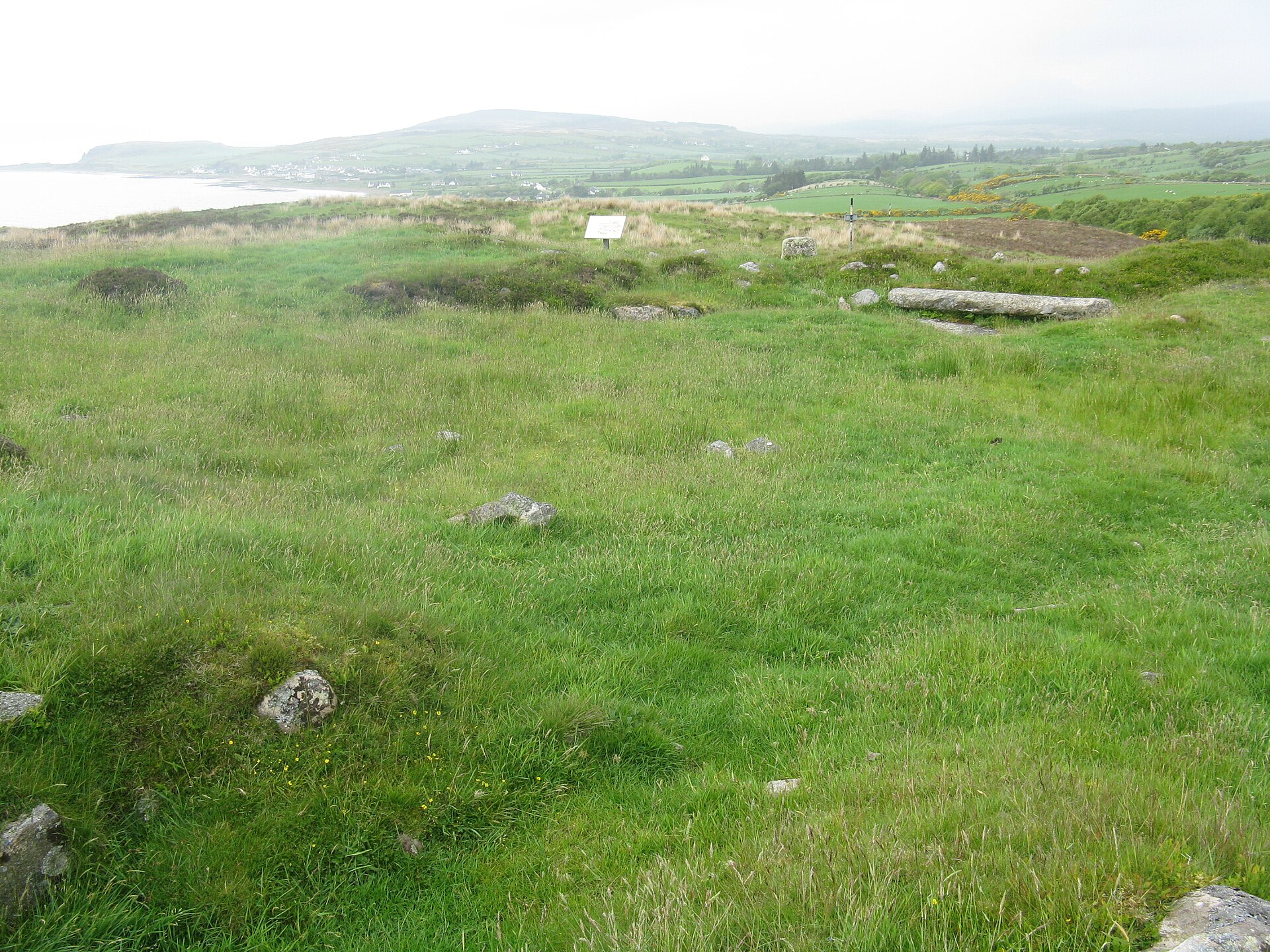
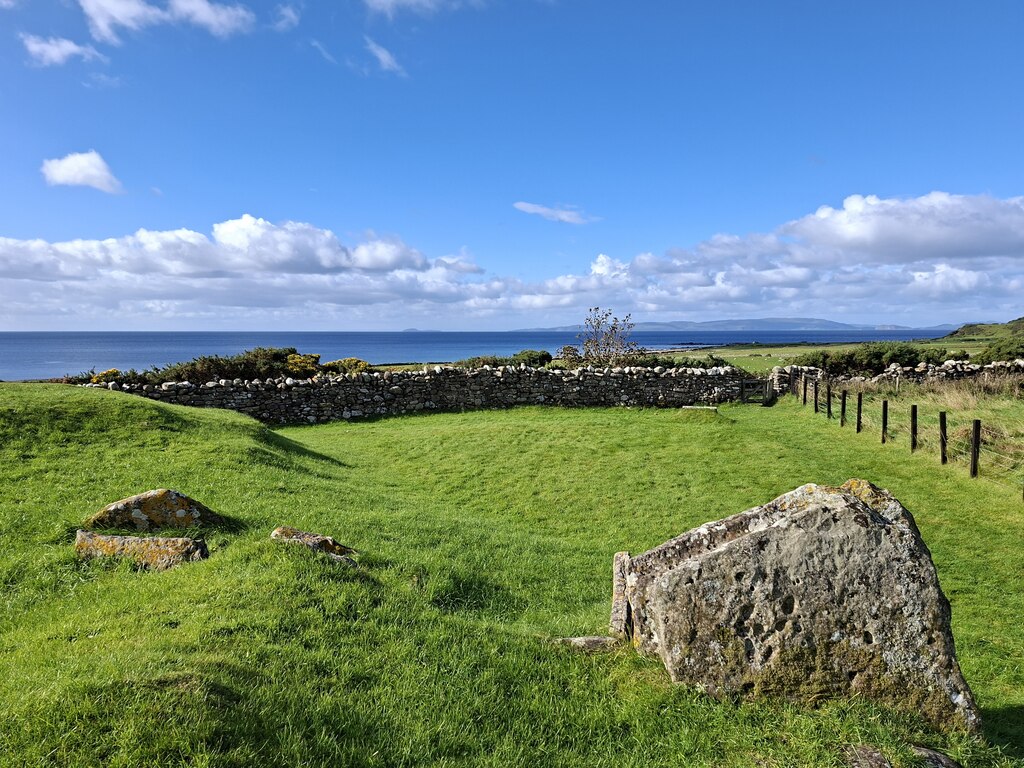
A grassy knoll rises apart from the surrounding west-coast fields of Arran. Torr a’Chaisteal is an Iron Age dun, a compact fortified homestead, with turf-covered sandstone walling and traces of an outer work on the landward side.
The interior is modest, but the setting gives the place its strength. Antiquarian excavation in the 19th century found bones, shells, a quern stone and pieces of haematite iron, offering a small glimpse of activity inside and around the stronghold.
What follows is drawn from published sources, with each claim labelled by how firmly it is established.
History
Torr a'Chaisteal is an Iron Age fort or dun on the Isle of Arran. A dun is a compact fortified homestead, one of a wider class of later Iron Age defended sites in western Scotland. The monument stands on an isolated grassy knoll on Arran's west coast, north-east of Sliddery.
The turf-covered walls are formed from large sandstone boulders. A short stretch of wall lies east of the dun. A substantial earthwork on the landward approach may have formed an outer defence.
Nineteenth-century antiquarian excavation uncovered human and animal bones, shells, the top stone of a quern and pieces of haematite iron. The pack notes Kilpatrick Dun, farther north, as a useful Arran comparison.
What to look for
-
Isolated knoll
The fort uses a naturally prominent grassy rise.
-
Sandstone walling
Large sandstone boulders form the turf-covered defensive wall.
-
Outer earthwork
The landward approach preserves an earthwork that may have served as an additional defence.
-
Compact enclosed area
The defended interior is small, fitting the dun interpretation.
Plan your visit
- Location
- 55.4590°N · 5.2886°W
- Access
- Open access
- Terrain
- Moderate walking
Opening & admission
The pack gives a Historic Environment Scotland designation; check current official access information before travelling.
- The dun stands on an isolated grassy knoll on Arran's west coast.
- A landward earthwork may have served as an outer defence.
Nearby places
Questions people ask
- What is Torr a'Chaisteal?
- It is an Iron Age dun, meaning a compact fortified homestead, on Arran's west coast.
- What was found at Torr a'Chaisteal?
- Nineteenth-century digging found human and animal bones, shells, a quern stone and pieces of haematite iron.
- What are the walls made from?
- The pack describes turf-covered walls formed from large sandstone boulders.
- What nearby site is similar?
- The pack names Kilpatrick Dun, farther north, as a comparable Arran site.
Sources
Explore more: Fortified places · Iron Age · North Ayrshire
The Ancient Codex, in your pocket
Get the Pocket Codex app
Carry the directory with you — Torr a'Chaisteal and thousands of ancient places across Britain and Ireland, offline, wherever you roam.