
About 200 upright stones, none more than a metre high, are set in rows running roughly north-south down the slope at Mid Clyth. The rows are not parallel but splay into a fan-shaped pattern; the…
Hill o’ Many Stanes is a carved stone near Lybster, Highland, Scotland.
What follows is drawn from published sources, with each claim labelled by how firmly it is established.
The name
The name 'Hill o' Many Stanes' is Scots for 'hill of many stones', describing the roughly 200 small upright stones set across the hillside at Mid Clyth.
History
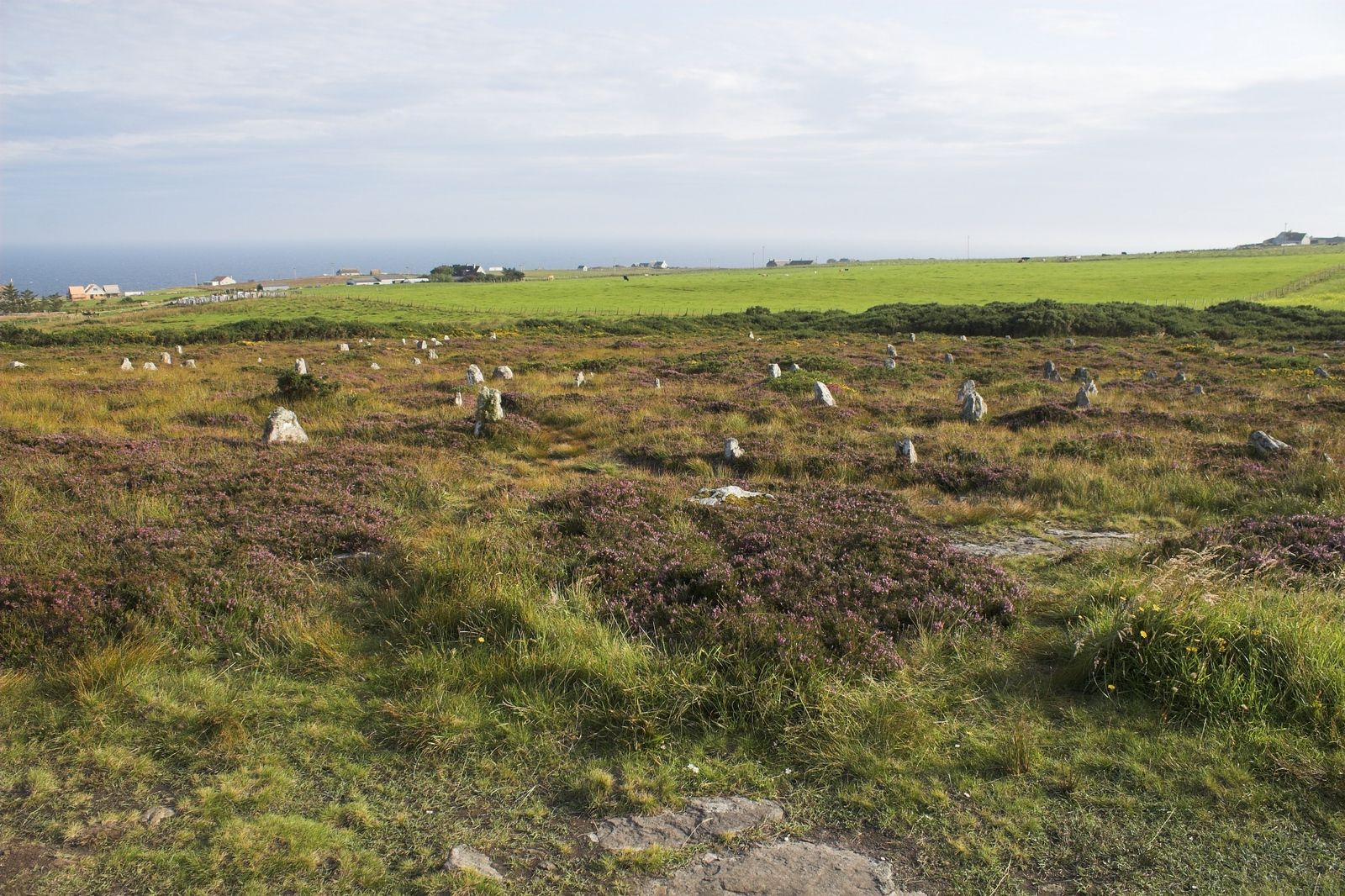
About 200 upright stones, none more than a metre high, are set in rows running roughly north-south down the slope at Mid Clyth. The rows are not parallel but splay into a fan-shaped pattern; the arrangement is believed to date from the Bronze Age.
More than twenty similar stone rows are now known across Caithness and Sutherland; such low stone rows are unknown elsewhere in Britain, though rows of much taller stones occur in Brittany.
People
-
Alexander Thom
Proposed in 'Megalithic Lunar Observatories' (1971) that the rows functioned as a Bronze Age lunar observatory
Cultural influences
-
Caithness-Sutherland stone-row tradition — the site belongs to a distinctly northern Scottish group of multiple low stone rows, a form with no parallel elsewhere in Britain.
Connections
-
Caithness and Sutherland stone rows
One of more than twenty similar multiple-stone-row sites known across these two northern counties
-
Stone rows of Brittany
Cited as a comparable (though much taller) tradition of stone rows outside Britain
In culture
-
In 'Megalithic Lunar Observatories' (Oxford University Press, 1971) Alexander Thom argued the rows served as a Bronze Age lunar observatory tracking the moon over an 18.6-year cycle — though none of the twenty-plus similar Caithness and Sutherland rows has been linked to astronomical use, leaving the claim much debated.
What to look for
-
The roughly 200 upright stones, none taller than a metre, set in rows down the incline.
-
The fan-shaped layout — the rows run approximately north-south but are not parallel, splaying outward across the slope.
-
The long northward view: on a clear day the hills of the Banffshire coast can be seen across the Moray Firth some 80 km away — the sightline at the centre of Thom's lunar-observatory argument.
What is said
Folklore and tradition, recorded as what is said — not as established fact.
-
Alexander Thom proposed that, from the northern end of the rows, the moon at its most southerly rising could be observed setting over the Banffshire hills across the Moray Firth, making the site a Bronze Age lunar observatory tracking an 18.6-year cycle. (contested; no other Caithness or Sutherland stone row has been linked to astronomical observation)
Plan your visit
- Location
- 58.3285°N · 3.2050°W
- Nearest settlement
- Lybster
- Access
- Open access
- Terrain
- Easy going
- Start point
- Hill o’Many Stanes · At Mid Clyth, 4m North East of Lybster on A99.
- Best time
- Open year-round.
- Start point
- Mid Clyth (roadside at the site, off the A99) (parking unconfirmed) — The fan of stones sits right beside a minor road off the A99 at Mid Clyth; visitors pull in at the roadside. No dedicated car park is confirmed.
- Sat-nav
- ND 295 384
Opening & admission
Free entry
- Open year-round.
Nearby places
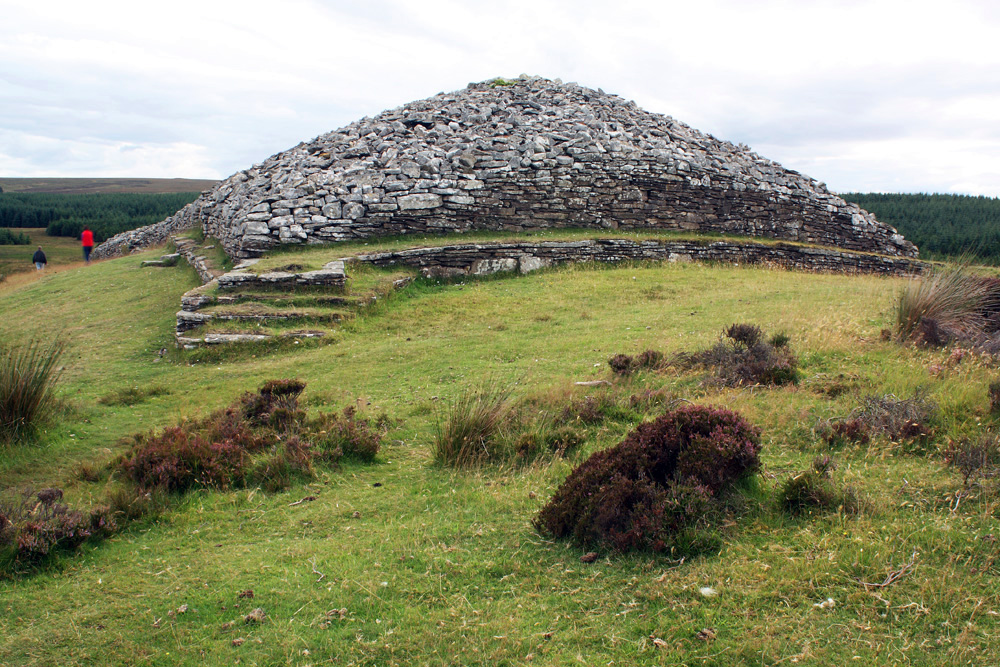
Tomb or burial place · Prehistoric
Grey Cairns of Camster
Highland
The two cairns were built in the third or fourth millennium BC — around 3,000 BC — making them among the oldest structures in Scotland. They are ex…
- Near Lybster
- 120 metres from car park
- Easy path
Sources
- Canmore site record 8604 (accessed 2026-06-13)
- Trove (HES) record (accessed 2026-06-13)
- Wikipedia: Hill o' Many Stanes (accessed 2026-06-13)
- Wikidata Q906555 (accessed 2026-06-13)
Explore more: Carved stones · Prehistoric · Highland
The Ancient Codex, in your pocket
Get the Pocket Codex app
Carry the directory with you — Hill o' Many Stanes and thousands of ancient places across Britain and Ireland, offline, wherever you roam.