
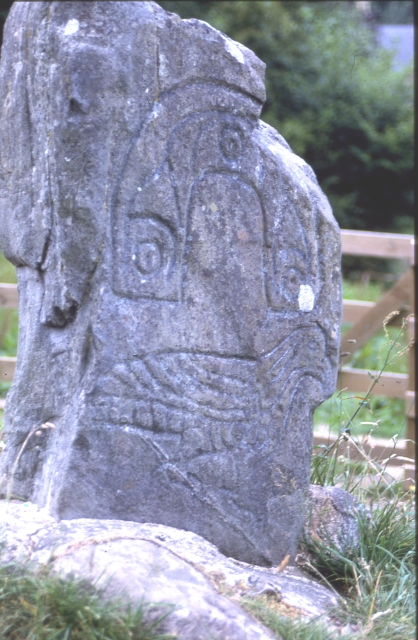
A symbol stone once reused as a church doorway lintel was identified at Dingwall. The Dingwall Stone is a Class I Pictish stone, an unshaped stone carrying Pictish symbols without a carved cross.
Some think the stone may have Bronze Age origins, with cup and ring marks alleged to date from that earlier period. If so, the Picts later reused the stone, carving symbols including a crescent and V-rod, a double-disc and Z-rod, and further crescent-and-Z-rod forms.
What follows is drawn from published sources, with each claim labelled by how firmly it is established.
History
The stone may have originated in the Bronze Age, though the source pack frames this as a view held by some.
Cup and ring marks on the stone are alleged to date from that earlier period.
The Picts later reused the stone and carved symbols on both sides.
The stone was being used as a lintel over a church doorway when it was identified in 1880.
Connections
-
Dingwall
Easter Ross town where the stone was identified.
-
Pictish symbol tradition
Regional carving tradition represented by the stone.
What to look for
-
Crescent and V-rod
Symbol on one side of the stone.
-
Double-disc and Z-rod
Symbol on the other side.
-
Reused lintel history
The stone had been built over a church doorway before identification.
Plan your visit
- Location
- 57.5974°N · 4.4289°W
- Access
- Open access
- Terrain
- Easy going
Opening & admission
- Stone identified in church fabric; current public access not established by source pack.
Nearby places

Fortified place · Medieval
Inverness Castle
Highland
It marks a site fortified for close to a thousand years and bound up with pivotal moments of Highland and Scottish history, from Robert the Bruce t…
Questions people ask
- What is the Dingwall Stone?
- It is a Class I Pictish stone found in Dingwall, Easter Ross.
- Was it Bronze Age?
- The source pack says some think it may be Bronze Age in origin.
- What symbols does it carry?
- It has crescent and V-rod symbols, plus a double-disc and Z-rod.
- How was it identified?
- It was being used as a lintel over a church doorway when identified in 1880.
Sources
Explore more: Carved stones · Pictish & early medieval · Highland
The Ancient Codex, in your pocket
Get the Pocket Codex app
Carry the directory with you — Dingwall Stone and thousands of ancient places across Britain and Ireland, offline, wherever you roam.