
Most brochs were built between 100 BC and 100 AD; Dun Carloway was probably built in the 1st century AD and remained in use through the centuries until the floor level rose too high from the build-up…
Dun Carloway Broch (an Iron Age drystone round tower) is a fortified place near Carloway, Outer Hebrides, Scotland.
What follows is drawn from published sources, with each claim labelled by how firmly it is established.
The name
The name comes from the Scottish Gaelic Dùn Chàrlabhaigh. The first element, dùn, means 'fort' in Gaelic and is commonly used for prehistoric or early-historic fortified sites including brochs. The second element, Càrlabhaigh, names the district of Carloway; its exact meaning is uncertain but most scholars connect it to Old Norse, reflecting Norse settlement of the Hebrides between the 9th and 13th centuries — a widely accepted reading links it to the Norse personal name Karl plus vágr ('bay/inlet'), giving roughly 'Karl's bay'. The full name Dùn Chàrlabhaigh thus means 'the fort of Carloway'.
History
Most brochs were built between 100 BC and 100 AD; Dun Carloway was probably built in the 1st century AD and remained in use through the centuries until the floor level rose too high from the build-up of occupation layers.
The broch was occasionally reused as a stronghold in later times. In 1601 the Morrisons of Ness occupied it after stealing cattle from the MacAuleys of Uig; the MacAuleys tracked them down and, the story goes, Donald Cam MacAuley scaled the outer wall using two daggers and smoked the Morrisons out by throwing burning heather inside, after which the MacAuleys destroyed the broch.
By the mid-19th century much of the top of the wall had gone, its stones reused in other buildings; the state of the broch in 1861 is shown in a drawing published in 1890 by Captain Thomas.
To prevent further decay, in 1882 Dun Carloway became one of the first officially protected monuments in Scotland, and from 1887 it has been in state management; later restoration has been carried out.
People
-
Donald Cam MacAuley
Of the MacAuleys of Uig; in the 1601 tradition, climbed the broch's outer wall with two daggers and smoked out the Morrisons of Ness
-
Captain Thomas
Recorded the broch's condition in an 1861 drawing, published in 1890
Cultural influences
-
Dun Carloway is the best-preserved broch in the Outer Hebrides; its wall rises on the south side to 9.2 m, exceeded only by Mousa Broch and Dun Telve.
-
Its later reuse as a clan stronghold and its survival into the antiquarian era made it a relic of the Kingdom of the Isles and, in 1882, one of Scotland's earliest legally protected monuments.
Connections
-
Mousa Broch
One of only two brochs (with Dun Telve) whose walls stand higher than Dun Carloway's
-
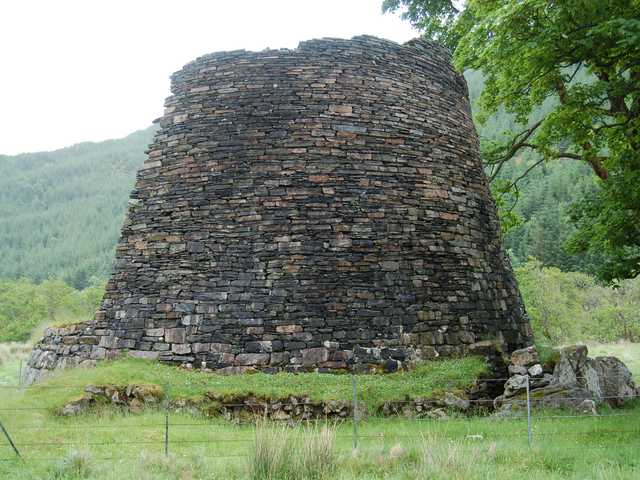
Photo: John Allan / Wikimedia Commons / CC BY-SA 2.0 Dun Telve
One of only two brochs (with Mousa) whose walls stand higher than Dun Carloway's
-
Kingdom of the Isles
Norse-era polity reflected in the broch's Old Norse-derived name (Karlavagr, 'Karl's bay')
Discovery & excavation
There was limited archaeological excavation at the beginning of the 20th century and again in the 1970s. Excavation in the north-eastern room found at least three peat-ovens used in the period 400–700, together with much pottery, a quern-stone fragment and a collection of snail shells. The fireplaces contained no animal bones, making domestic meal-preparation unlikely, and the absence of iron-working tools makes an industrial use unlikely too — so the room was probably used only for making earthenware pots.
What to look for
-
The dramatically preserved drystone wall, rising on the south side to about 9.2 m — the tallest surviving broch wall in the Outer Hebrides.
-
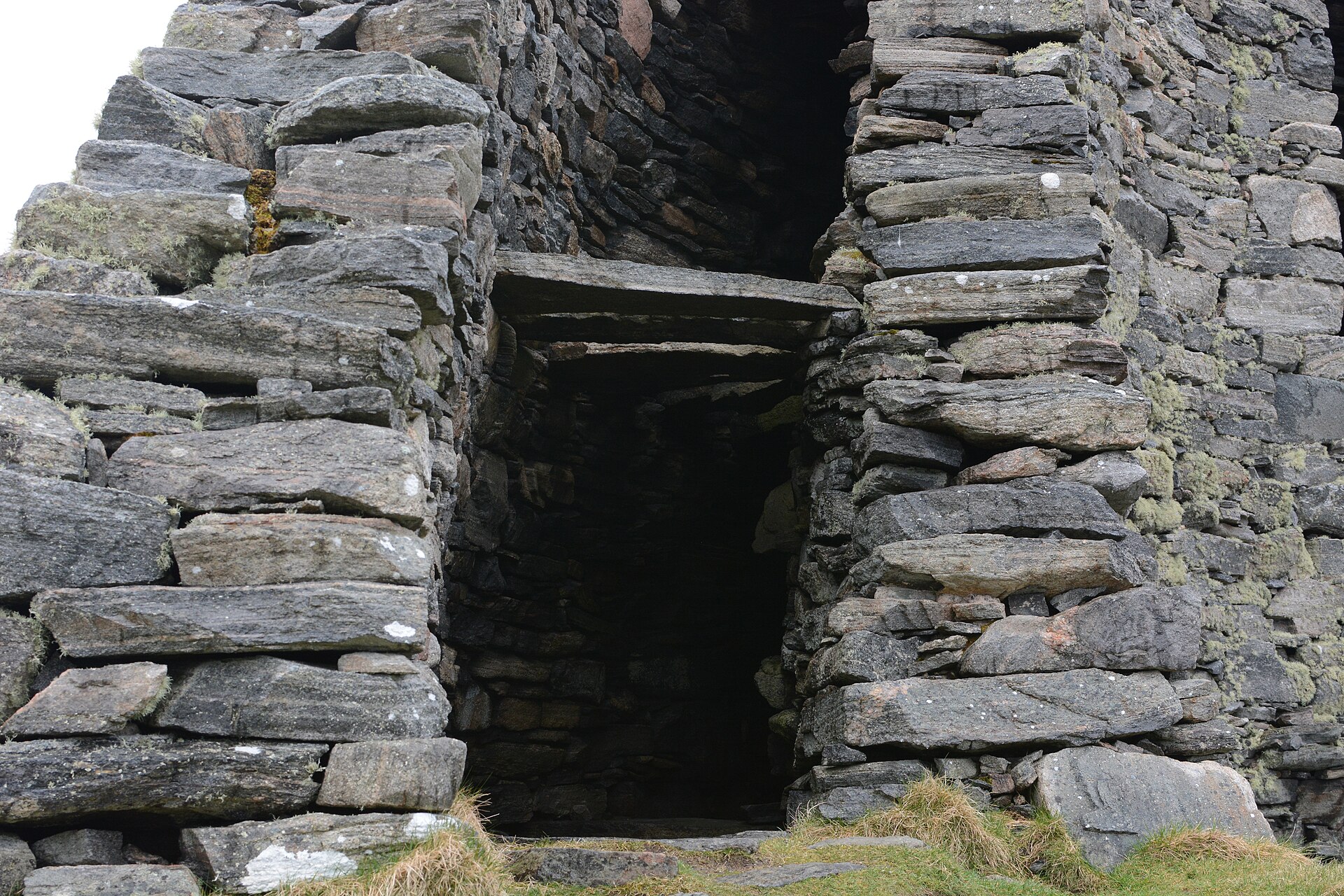
The low entrance on the north-west side (about 75 cm wide and 1 m high), with a 'guard cell' opening off the south side of the entrance passage.
-
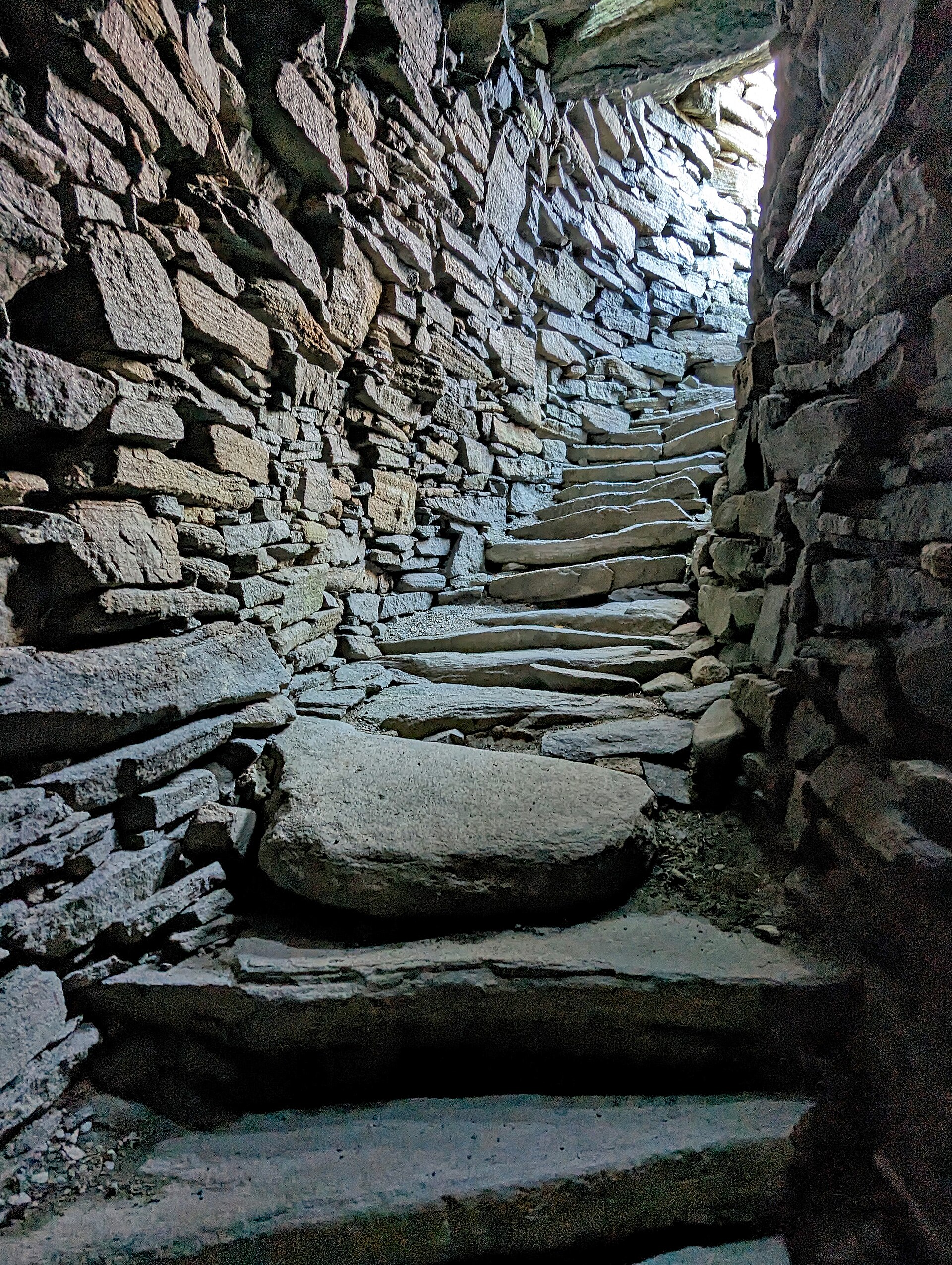
Inside the courtyard, openings leading to the intra-mural staircase (which runs around a quarter of the broch's circumference), an oval room with traces of peat ovens, and a room beneath the stairs.
-
The scarcement (ledge) about 2 m above ground level, marking where an upper wooden floor is likely to have rested.
-
Its setting on a rocky south-facing slope at about 50 m, overlooking Loch Carloway.
What is said
Folklore and tradition, recorded as what is said — not as established fact.
-
The 1601 episode is told as a story: that Donald Cam MacAuley climbed the broch's outer wall using two daggers and smoked out the Morrisons of Ness by setting fire to heather thrown inside, after which the broch was destroyed. (tradition)
Plan your visit
- Location
- 58.2696°N · 6.7940°W
- Nearest settlement
- Carloway
- Access
- Open access
- Terrain
- Moderate walking
- Parking
- Parking available nearby — see the official getting-here page.
- Start point
- Dun Carloway · 1.5m South of Carloway, about 16m North West of Stornoway, Lewis on the A858. · Access to the site is via a rough path across agricultural land. The access points into the site are low. Visitors are requested not to climb on the broch walls.
- Best time
- For visitor information, please call Arnol Blackhouse on 01851 710 395 Opening times Dun Carloway is free to visit.
- Start point
- Doune Broch Centre car park — Car park beside the Doune Broch (Dun Carloway) Visitor Centre off the A858; access to the broch is via a rough uphill path across agricultural land, and the entrances into the broch are low.
- Sat-nav
- NB 189 412
Opening & admission
Free entry
- For visitor information, please call Arnol Blackhouse on 01851 710 395 Opening times Dun Carloway is free to visit.
Nearby places
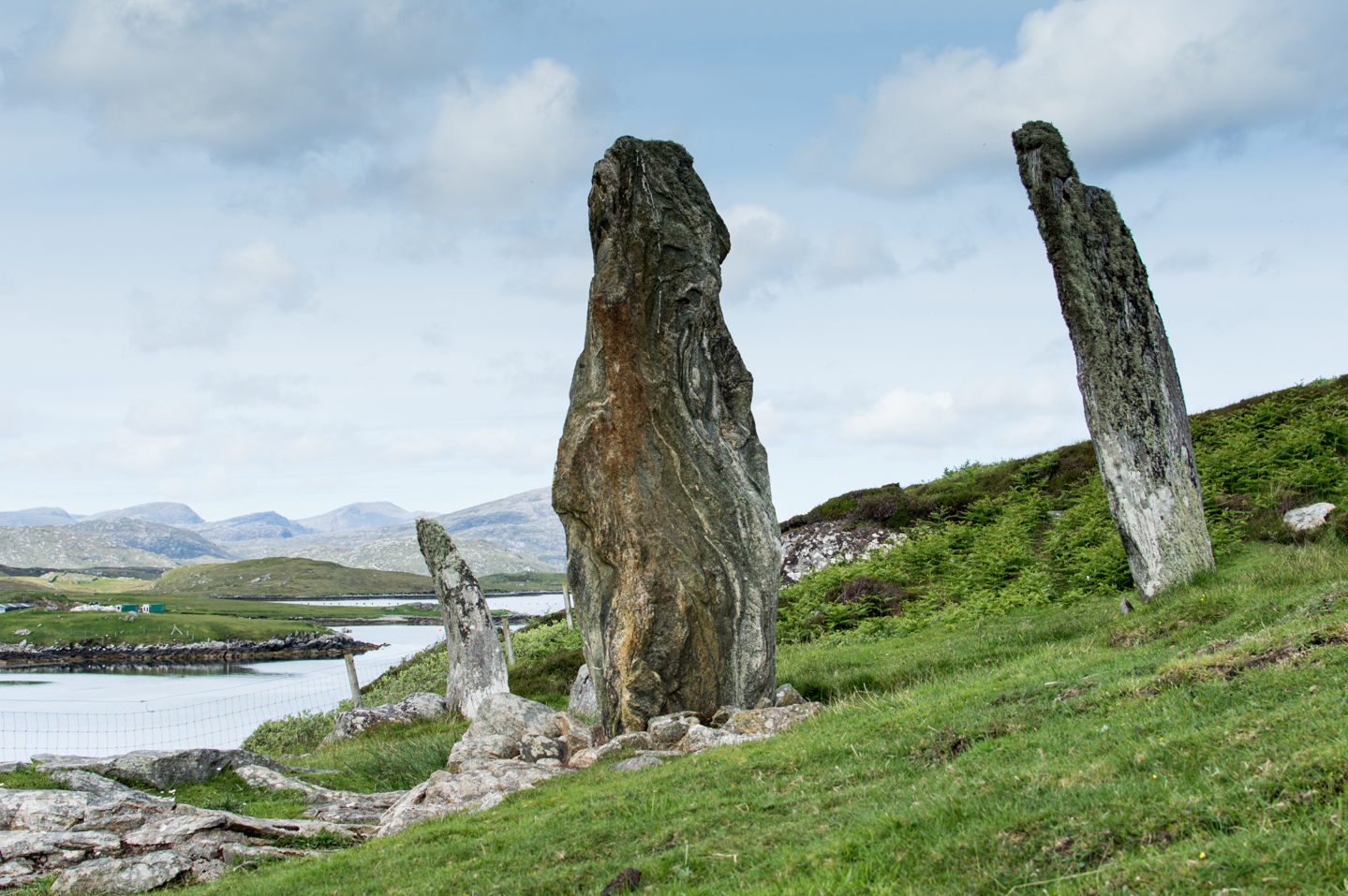
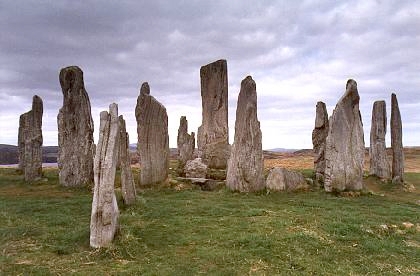
Carved stone · Prehistoric
Calanais Standing Stones
Outer Hebrides
The Calanais Stones are a prehistoric stone circle and stone alignment on a low ridge above Loch Roag on the Isle of Lewis, built during the Neolit…
- Near Calanais
- 107 metres from car park
- Easy path
Sources
- Canmore site record 4121 (accessed 2026-06-13)
- Wikipedia: Dun Carloway (accessed 2026-06-13)
- Wikidata Q1265209 (accessed 2026-06-13)
Explore more: Fortified places · Iron Age · Outer Hebrides
The Ancient Codex, in your pocket
Get the Pocket Codex app
Carry the directory with you — Dun Carloway Broch and thousands of ancient places across Britain and Ireland, offline, wherever you roam.