
The chambered cairn was built around 2800 BC by Neolithic farming communities of central Orkney, associated with the Grooved ware pottery tradition; as the largest and most sophisticated…
Maeshowe Chambered Cairn is a tomb or burial place near Stenness, Orkney, Scotland.
What follows is drawn from published sources, with each claim labelled by how firmly it is established.
The name
Maeshowe appears in the medieval Orkneyinga saga as the Old Norse Orkahaugr — haugr meaning 'mound' and Orka either a personal name or 'Orkney', so usually read as 'Ork's mound' or 'the mound of Orkney'. The modern name developed later from Scots; 'howe' derives from haugr, while the first element 'Maes' is uncertain (Hugh Marwick tentatively suggested Gaelic mas, 'rounded hillock'; a Welsh maes, 'field', has also been proposed, both regarded as doubtful).
History
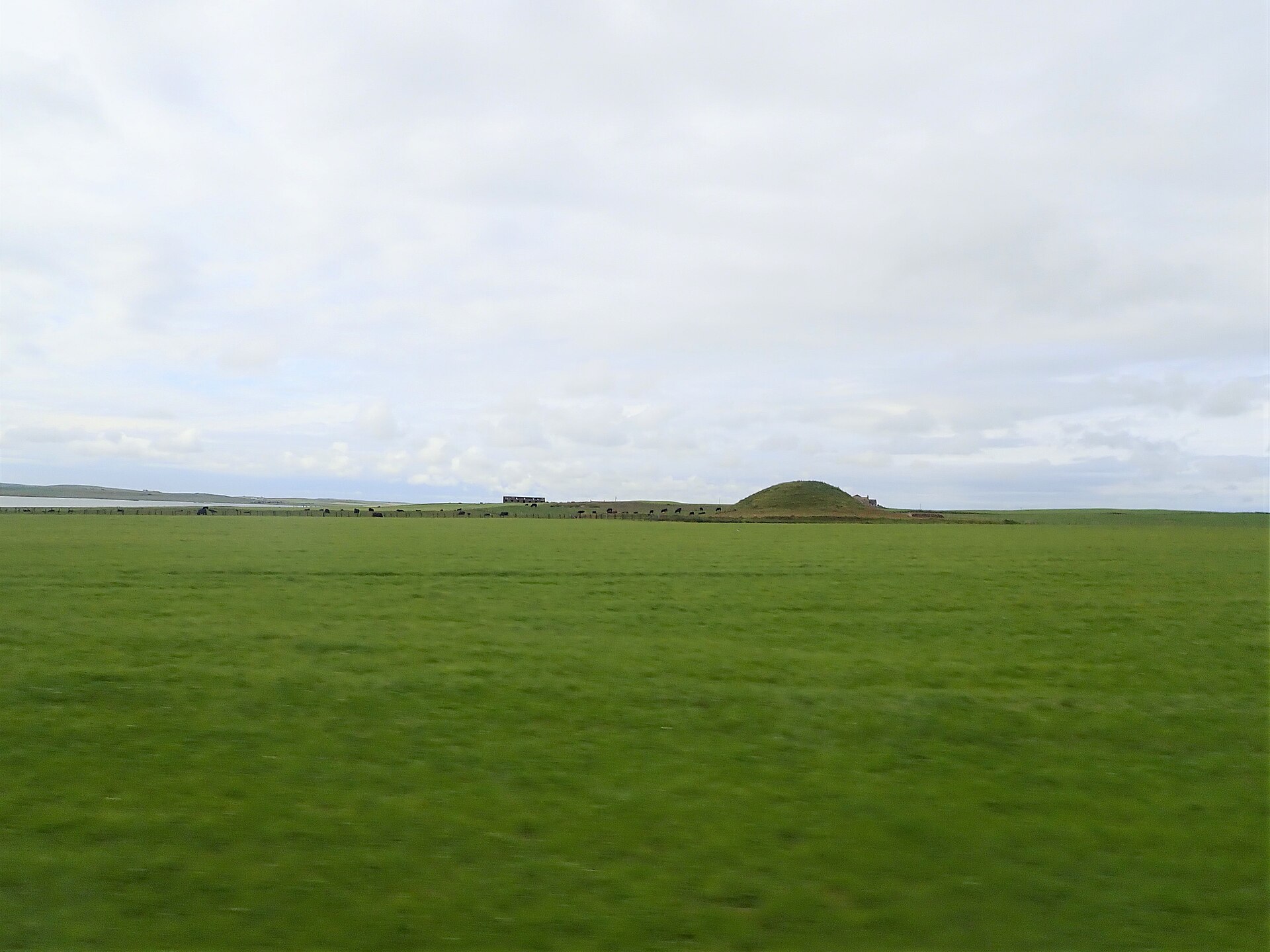
The chambered cairn was built around 2800 BC by Neolithic farming communities of central Orkney, associated with the Grooved ware pottery tradition; as the largest and most sophisticated Maeshowe-type tomb it may represent the final stage of that architectural tradition.
In the twelfth century AD, after the mound had stood for about four thousand years, Norse visitors broke in — apparently forcing entry through the roof — and carved more than thirty runic inscriptions into the chamber walls, the largest single collection of runes known from one location.
The tomb was opened in the modern era in July 1861 by the antiquarian James Farrer, MP, whose workmen broke through the roof and emptied the main chamber, exposing the runic inscriptions; excavation has shown the external wall around the ditch was rebuilt in the 9th century.
People
-
James Farrer
Antiquarian and MP for South Durham who carried out the 1861 'modern' opening of the tomb
-
Harald Maddadsson and Earl Rognvald
Leaders said in the Orkneyinga saga to have sheltered in the mound during a snowstorm and broken into the chamber seeking treasure
-
Stuart Piggott
Archaeologist who called Maeshowe 'a superlative monument... lifted out of its class into a unique position'
-
Portrait: Portable Antiquities Scheme from London, England / Wikimedia Commons / CC BY 2.0 Colin Renfrew
Archaeologist who estimated the monument may have required at least 100,000 hours of work
Cultural influences
-
The Maeshowe type of chambered cairn — a long, low entrance passage leading to a near-square chamber with side cells — which this tomb names and of which only about seven definite examples are known, all in Orkney.
-
A close similarity to the Newgrange passage tomb in Ireland, including a midwinter solar alignment, suggesting a link between the two cultures.
Connections
-
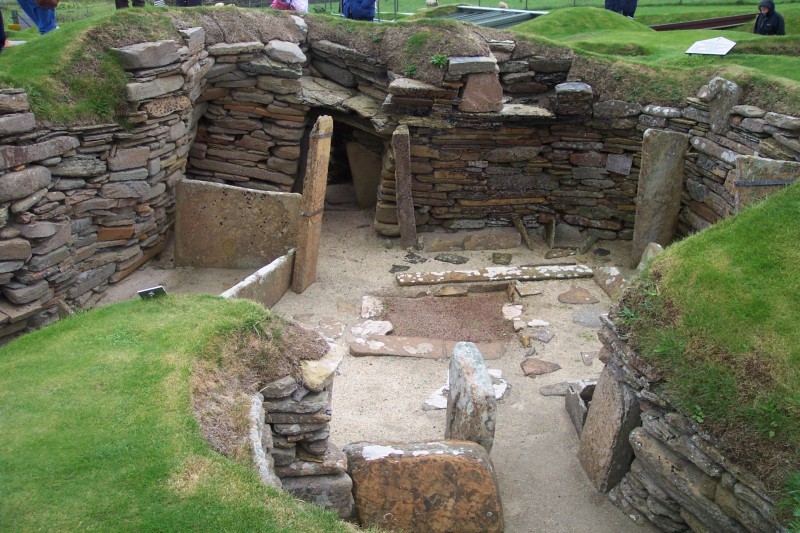
Photo: Dr. John F. Burka / Wikimedia Commons / CC BY-SA 3.0 Heart of Neolithic Orkney (UNESCO World Heritage Site)
Component monument, inscribed in 1999 alongside Skara Brae, the Stones of Stenness and the Ring of Brodgar
-
Ring of Brodgar and Stones of Stenness
Part of the same central-Orkney Neolithic ceremonial landscape
-
Barnhouse Settlement and the Barnhouse Stone
Aligned with Maeshowe — Structure 8's entrance faces the mound, and the Barnhouse Stone ~700 m away aligns with the entrance
-
Newgrange (Ireland)
Closely similar passage tomb with a comparable midwinter solar alignment
-
Other Maeshowe-type tombs (Cuween Hill, Wideford Hill, Quanterness, Quoyness, Vinquoy Hill, Holm of Papa Westray)
The small group of tombs sharing Maeshowe's distinctive plan
Discovery & excavation
The tomb was opened in July 1861 by James Farrer and his workmen, who broke through the entrance-passage roof — finding it filled with debris — then through the top of the mound, emptying the chamber over a few days. They found the famous runic inscriptions, proof that Norsemen had broken in at least six centuries earlier. No human remains were found at Maeshowe, unusually for a chambered tomb. The runes are still studied today using reflectance transformation imaging.
In culture
-
Described in Historic Environment Scotland's Statement of Significance as 'a masterpiece of Neolithic engineering... a unique survival from 5000 years ago' and 'an expression of genius'.
-
In 1971 Peter Tompkins proposed, comparing Maeshowe to the Great Pyramid, that the structure served as an observatory and calendar with 'retiring rooms' for observers rather than as a tomb.
What to look for
-
The grass-covered mound, about 35 m across and 7.3 m high, ringed by a wide ditch.
-
The long, low entrance passage (about 11 m, only ~0.9 m high) that must be stooped through before the chamber opens out.
-
The near-square central chamber (~4.6 m a side), with massive angled corner buttresses rising to a beehive-shaped corbelled vault.
-
The winter-solstice alignment — for a few days around midwinter the setting sun shines down the passage onto the rear wall of the chamber.
-
The Norse runic inscriptions cut into the chamber walls, including the boast that 'these runes were carved by the man most skilled in runes west of the ocean' and 'Ingigerth is the most beautiful of women'.
What is said
Folklore and tradition, recorded as what is said — not as established fact.
-
In the Orkneyinga saga the mound (Orkahaugr) is entered by a Norse party led by Harald Maddadsson and Earl Rognvald, who shelter from a snowstorm and break in seeking treasure; in Scandinavian folklore such mounds were thought to hold treasure guarded by draugar, the restless spirits of the dead. (saga account blends history and legend; broadly corresponds to archaeological evidence for 12th-century Norse entry)
Standing there
- From outside Maeshowe is a large grass-covered mound about 35 metres across rising over 7 metres high on the open Orkney plain, ringed by a broad ditch — a smooth green dome on flat farmland with the wide Mainland sky around it and the other Neolithic monuments in view.
- To enter you stoop or crawl along a low passage only about 0.9 metres high and some 11 metres long before the space suddenly opens into a tall central chamber roughly 4.6 metres square — the bodily experience is one of confinement and darkness giving way to a cool, enclosed stone room.
- Inside, the walls are built of huge flat flagstone slabs — some weighing as much as 30 tons — with massive angled stones standing in each corner, so the chamber is hard, cold, silent and echoing, the air still and earth-cool after the bright exposed mound outside.
- The tomb is aligned so that at the winter solstice the setting sun shines straight up the entrance passage and strikes the rear wall of the chamber — for a few midwinter days a shaft of low golden light reaches into the dark interior, an effect deliberately engineered around 2800 BC and still witnessed today.
- For its Neolithic builders, gathering in the lightless chamber by the glow of the midwinter sun or a small fire would have made this a charged, otherworldly space — entered on hands and knees from the daylight into a stone-walled dark held back only by that single annual beam of sun.
Plan your visit
- Location
- 58.9966°N · 3.1882°W
- Nearest settlement
- Stenness
- Access
- Paid entry — managed visitor site
- Terrain
- Easy going
- Start point
- Maeshowe Visitor Centre at Stenness · Ireland Road · Stenness · KW16 3LB · National Grid reference: HY 30268 11314 · Telephone: 01856 851 266
- Best time
- Buy Orkney Digital Guide Opening times Visits are by guided tour only, which depart from the Maeshowe Visitor Centre at Stenness village on the hour.
- Start point
- Maeshowe Visitor Centre car park, Stenness — Maeshowe can only be visited on a timed guided tour. Park at the Maeshowe Visitor Centre at Stenness (Ireland Road, KW16 3LB); a shuttle bus takes visitors from the centre to the cairn. Booking online in advance is strongly recommended. The straight-line distance shown is to the cairn from the visitor centre, not a walking route.
- Sat-nav
- KW16 3LB
Opening & admission
Free entry
- Buy Orkney Digital Guide Opening times Visits are by guided tour only, which depart from the Maeshowe Visitor Centre at Stenness village on the hour.
Nearby places
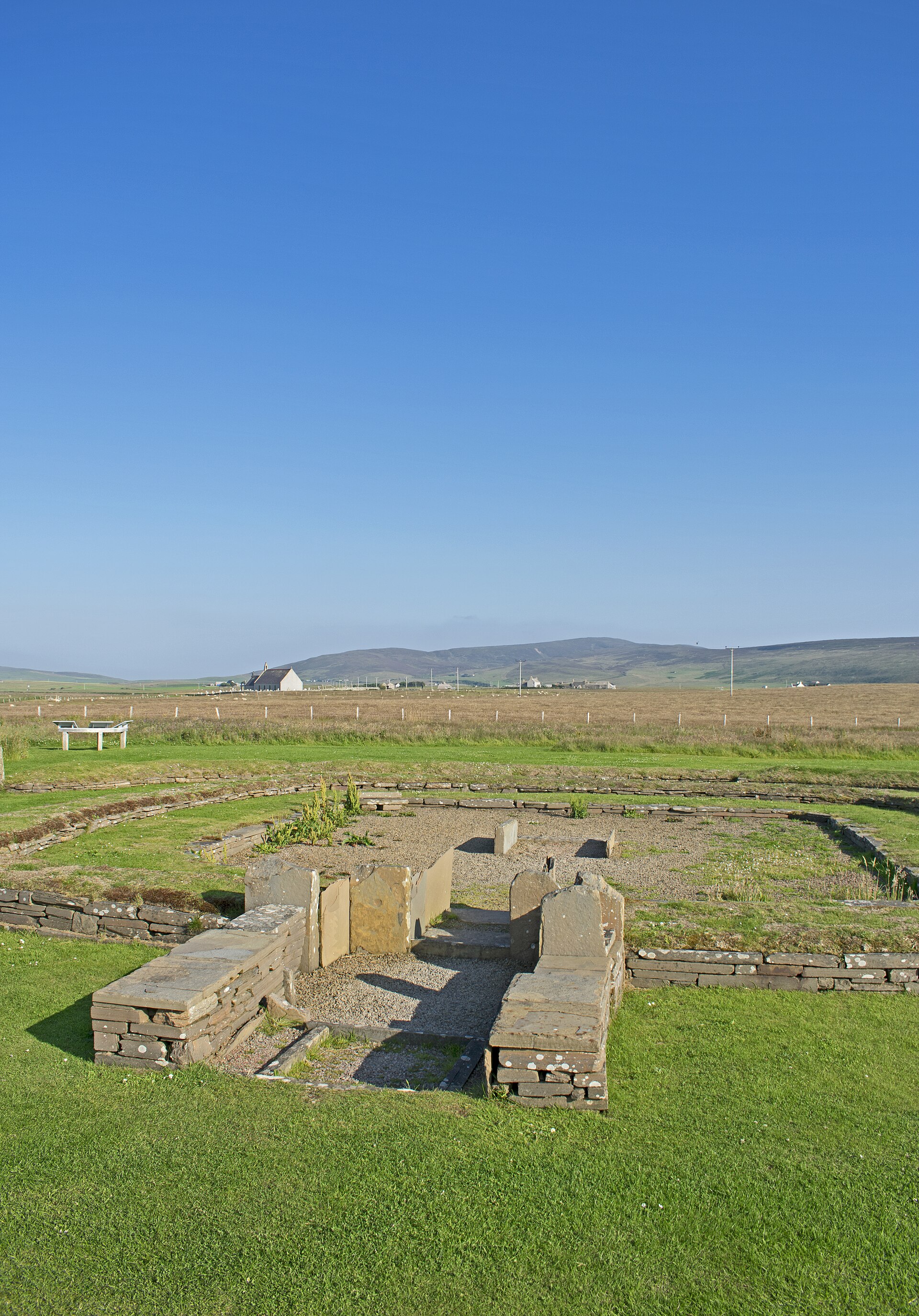
Carved stone · Prehistoric
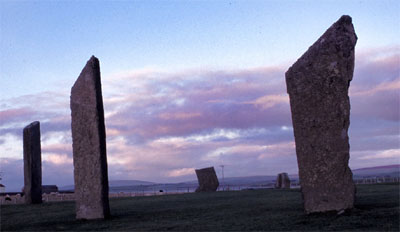
Stones of Stenness Circle and Henge
Orkney Islands
The Stones of Stenness are a Neolithic monument and may be the oldest henge site in the British Isles; radiocarbon dating indicates work on the sit…
- Near Stenness
- 2 min walk from car park
- Easy path
Sources
- Canmore site record 2094 (accessed 2026-06-13)
- Wikipedia: Maeshowe (accessed 2026-06-13)
- Wikidata Q507076 (accessed 2026-06-13)
Explore more: Tomb or burial places · Prehistoric · Orkney Islands
The Ancient Codex, in your pocket
Get the Pocket Codex app
Carry the directory with you — Maeshowe Chambered Cairn and thousands of ancient places across Britain and Ireland, offline, wherever you roam.