
Broken towers and curtain walls at Spynie preserve the long residence of Moray’s medieval bishops. Spynie Palace, also known as Spynie Castle, was a fortified episcopal seat, a defended residence for bishops, used by the Bishops of Moray for about five centuries.
The palace matters because it stayed important even after the cathedral seat moved to Elgin. Its story runs from a late-12th-century wooden castle through stone towers, Reformation politics, Covenanter sieges and modern stabilisation before opening under Historic Scotland in 1994.
What follows is drawn from published sources, with each claim labelled by how firmly it is established.
The name
Episcopal means relating to a bishop; an episcopal palace is therefore a bishop's residence.
History
The founding of Spynie Palace dates to the late 12th century. Pope Innocent III gave permission in 1206 for the Bishop of Moray's permanent move to Spynie.
Although the cathedral seat moved to Elgin in 1224, the Bishop of Moray's palace remained at Spynie. Excavations from 1986 to 1994 revealed the first wooden castle, enclosed by a ringwork and ditch.
Stone buildings developed from the 13th century onward, with major accommodation added in the later 15th and 16th centuries. David's Tower was begun by Bishop David Stewart and completed by Bishop William Tulloch.
Bishop Patrick Hepburn strengthened the defences during the mid-16th century and continued living there after the Reformation. Bishop John Guthrie surrendered Spynie to Covenanter forces under Sir Robert Monro in 1640.
The palace came into state care in the 20th century and opened to the public under Historic Scotland in 1994.
People
-
Bricius de Douglas
Bishop who received papal permission for the move to Spynie and sought the later transfer of the see to Elgin.
-
Bishop Andrew of Moray
Carried out the transfer of the see to Elgin while Spynie remained the bishop's palace.
-
Alexander Stewart, Earl of Buchan
The Wolf of Badenoch, linked to conflict around Elgin Cathedral and Spynie Castle in 1390.
-
Bishop David Stewart
Began David's Tower in the later 15th century.
-
Bishop William Tulloch
Completed David's Tower.
-
Bishop Patrick Hepburn
Strengthened Spynie's defences and remained there after the Reformation.
-
Bishop John Guthrie
Royalist bishop who surrendered the castle during the 1640 Covenanter siege.
What to look for
-
David's Tower
The great tower was the largest by volume of all medieval Scottish towers in the source account.
-
Curtain wall
A curtain wall is a defensive wall enclosing a castle or palace courtyard.
-
Ringwork and ditch
The earliest excavated castle was a wooden structure within a ringwork, an earthwork enclosure, and ditch.
-
Portcullis gate
The later east gate had a portcullis, a heavy gridded barrier lowered to block an entrance.
-
Vaulted basement and dungeon
David's Tower contained a vaulted basement and circular dungeon below courtyard level.
-
Stabilised ruin
Late-20th-century works stabilised the tower and disguised a concrete plinth behind reinstated walling.
Plan your visit
- Location
- General area near Moray, Moray
- Terrain
- Moderate walking
Opening & admission
- Historic Scotland opened the stabilised ruin to the public in 1994.
- Ruined palace surfaces and tower areas may involve steps and uneven ground.
This is a sensitive or fragile site, so we show only its general area. Please check official heritage sources for access before visiting, and take care not to disturb it.
Nearby places
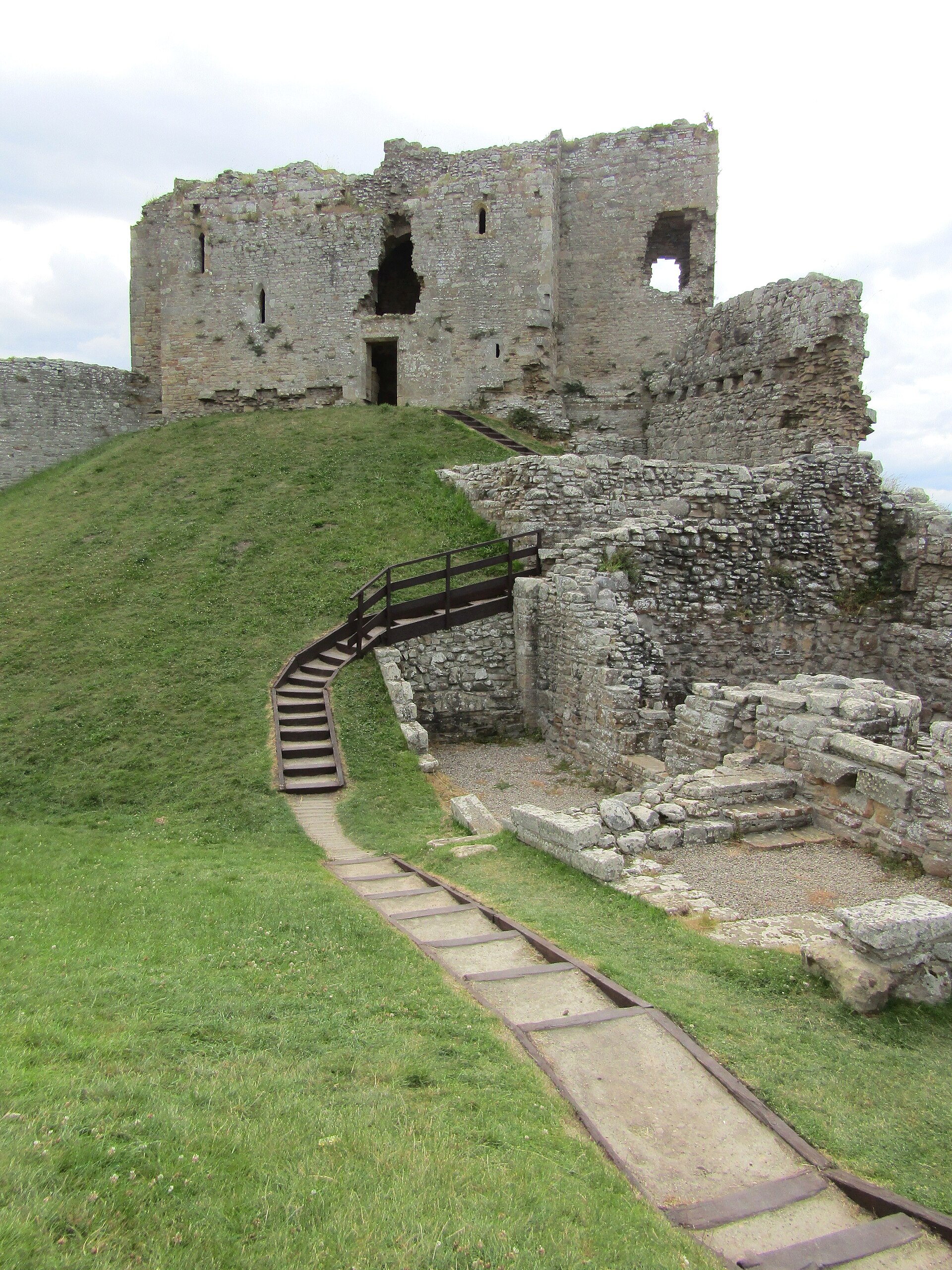
Fortified place · Medieval
Duffus Castle
Moray
Duffus Castle shows the rise and fall of a Norman-founded Moray lordship, from a twelfth-century timber motte to a stone tower undone by the very m…
Minor monument · Medieval
Ogston Market Cross, Michael Kirk, Gordonstoun
Moray
Mercat cross with HES-listed pre-1800 evidence (1705).
- Easy path
Questions people ask
- What is Spynie Palace?
- It is the fortified former seat of the Bishops of Moray at Spynie in Moray.
- What does episcopal seat mean?
- It means a place associated with a bishop's authority or residence.
- Why did Spynie remain important after 1224?
- The cathedral see moved to Elgin, but the Bishop of Moray's palace remained at Spynie.
- What is David's Tower?
- It is the major late-medieval tower at Spynie, begun by Bishop David Stewart and completed by Bishop William Tulloch.
- When did Spynie Palace open to the public?
- It opened under Historic Scotland in 1994 after major stabilisation work.
Sources
Explore more: Fortified places · Medieval · Moray
The Ancient Codex, in your pocket
Get the Pocket Codex app
Carry the directory with you — Spynie Palace and thousands of ancient places across Britain and Ireland, offline, wherever you roam.