
Woodland on the Knock of Alves covers a hilltop with ruined fort walls, a stone circle and later memorial buildings. The Knock of Alves is a prehistoric and early-medieval hill site, with a hillfort, a defended enclosure on high ground, and a stone circle on the south side of the hill.
The hill matters because it gathers several layers of Moray’s past on one wooded rise. Iron Age and Pictish occupation are recorded at the fort, the stone circle survives below the summit, and York Tower and the Forteath Mausoleum show how the hill was reinterpreted in the 19th century.
What follows is drawn from published sources, with each claim labelled by how firmly it is established.
The name
A stone circle is a prehistoric setting of standing stones arranged in a ring or near-ring.
History
York Tower was erected on the summit in 1827 to commemorate Prince Frederick, the Duke of York.
The Forteath Mausoleum was built in 1850 as the burial place of members of the Forteath family of Newton.
The hillfort shows evidence of both Iron Age and Pictish occupation.
The fort was surveyed by the Royal Commission on the Ancient and Historical Monuments of Scotland in 1957.
Excavations in 2016 produced Iron Age dates from the upper citadel and early-medieval dates from the lower ramparts.
The stone circle on the south side of the hill consists of six boulders.
People
-
Prince Frederick, Duke of York
Commemorated by York Tower on the summit.
-
Forteath family
Family associated with Newton whose mausoleum was built on the hill in 1850.
What to look for
-
Stone circle
Six boulders form the recorded stone circle below the summit.
-
Ruined hillfort walls
The fort remains have been damaged by later buildings, roads, roots, burrowing and erosion.
-
Vitrified-fort group
The hillfort is commonly grouped with other massively built forts that often show vitrification, or heat-altered rampart stone.
-
York Tower
The 19th-century tower gives the summit a later commemorative landmark.
What is said
Folklore and tradition, recorded as what is said — not as established fact.
-
Tradition held that an early Christian church, possibly Culdean, stood on the hill, although the source says no traces have been found.
Plan your visit
- Location
- 57.6480°N · 3.4040°W
- Access
- Open access
- Terrain
- Moderate walking
Opening & admission
- Wooded hill with summit monuments, hillfort remains and stone circle.
- The source does not confirm a managed visitor route to the prehistoric features.
Nearby places
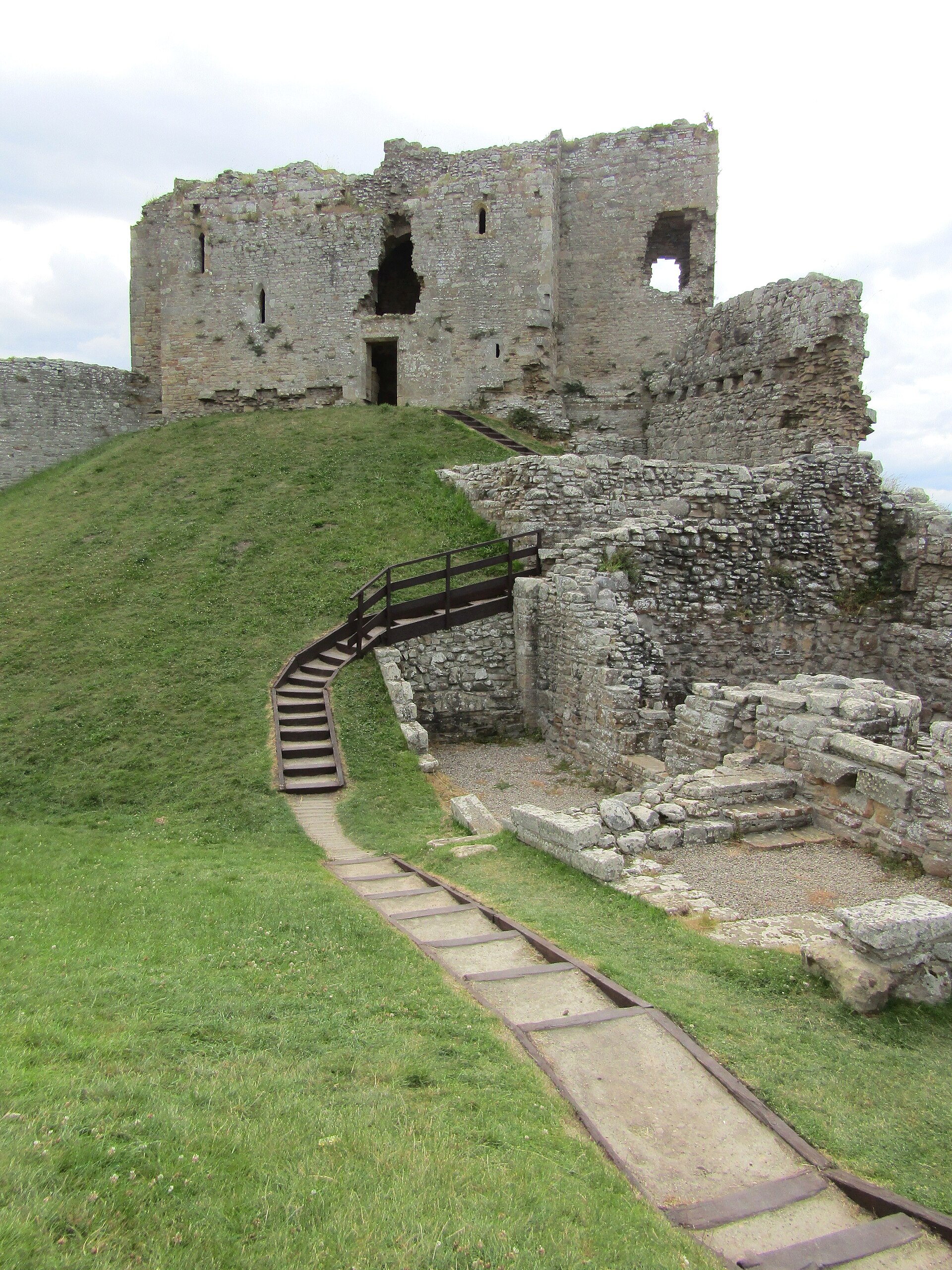
Fortified place · Medieval
Duffus Castle
Moray
Duffus Castle shows the rise and fall of a Norman-founded Moray lordship, from a twelfth-century timber motte to a stone tower undone by the very m…
Questions people ask
- What is the Knock of Alves?
- It is a wooded hill west of Elgin with a hillfort, stone circle and later memorial buildings.
- What is a stone circle?
- A stone circle is a prehistoric arrangement of standing stones set in a ring or near-ring.
- How many stones are in the circle?
- The source describes six boulders in the stone circle.
- What periods are represented at the hillfort?
- Excavations indicate Iron Age activity on the upper citadel and early-medieval reoccupation or refortification on the lower ramparts.
- What is York Tower?
- It is an octagonal folly built in 1827 to commemorate Prince Frederick, the Duke of York.
Sources
Explore more: Tomb or burial places · Prehistoric · Moray
The Ancient Codex, in your pocket
Get the Pocket Codex app
Carry the directory with you — Knock of Alves and thousands of ancient places across Britain and Ireland, offline, wherever you roam.