
The cave is a long-standing place of Roman Catholic pilgrimage through its association with the Scottish saint Ninian.
St Ninian’s Cave is a sacred place near Whithorn, Dumfries and Galloway, Scotland.
What follows is drawn from published sources, with each claim labelled by how firmly it is established.
The name
The cave is named for Ninian, the early Scottish saint with whom it has long been associated; the site lies in Physgill Glen near Whithorn, the centre of Ninian's early Christian mission in Galloway.
History
The cave is a long-standing place of Roman Catholic pilgrimage through its association with the Scottish saint Ninian.
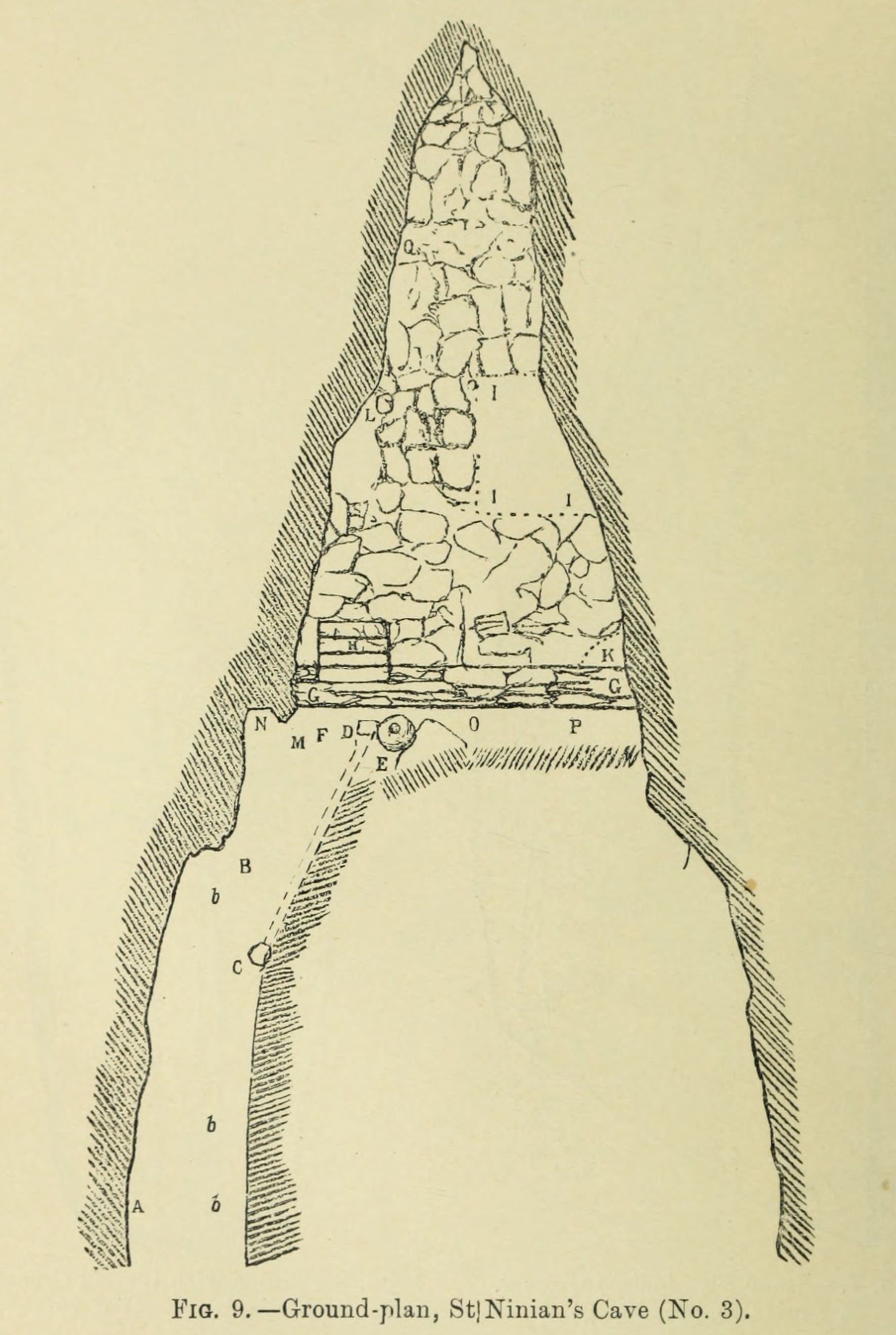
Excavations in the cave in the 1880s and again in the 1950s uncovered a collection of 18 early medieval carved stones - most of them built into a post-medieval wall, the rest lying loose in the cave's interior or at its mouth.
Rockfalls near the entrance have progressively diminished the size of the cave over time.
People
-

Portrait: Unknown authorUnknown author / Wikimedia Commons / Public domain Saint Ninian
Early Scottish saint with whom the cave is associated; focus of the pilgrimage tradition
Cultural influences
-
Early Christian Scotland - the cave's association with Ninian's Whithorn mission ties it to the earliest documented Christianity in Scotland, and the carved stones recovered here are of early medieval date.
Connections
-
Whithorn
The cave lies near Whithorn, the centre of St Ninian's early Christian mission in Galloway
-
Burrow Head
Neighbouring coastal headland on the same Galloway coast
Discovery & excavation
Excavations in the 1880s and the 1950s recovered 18 early medieval carved stones from the cave - the majority built into a post-medieval wall, with others lying loose inside the cave and at its mouth.
In culture
-
In 1973 the cave was used as a filming location for the horror film The Wicker Man.
What to look for
-
The cave mouth in Physgill Glen, now reduced in size by rockfalls near the entrance.
-
The setting that yielded the early medieval carved stones - recovered from the cave's interior, its mouth, and a post-medieval wall built within it.
Plan your visit
- Location
- 54.6938°N · 4.4507°W
- Nearest settlement
- Whithorn
- Access
- Permission required
- Parking
- Parking available nearby — see the official getting-here page.
- Start point
- St Ninian’s Cave · Physgill, on the coast 4m south west of Whithorn on the A747.
- Best time
- St Ninian's Cave is currently closed to allow for conservation works.
- Start point
- Physgill (Kidsdale) car park — Park at Physgill off the A747; a farm track leads down through the glen to the shore, then it is a walk along the shingle beach to the cave. Allow ~20-25 min each way. Cave currently closed for conservation works.
Opening & admission
Ticketed — check the official site for current prices
- St Ninian's Cave is currently closed to allow for conservation works.
Nearby places
Sacred place · Pictish & early medieval
Whithorn Priory and Museum
Dumfries and Galloway
Whithorn was the location of the first recorded Christian church in Scotland — Candida Casa, the 'White/Shining House' — built by Saint Ninian arou…
- Near Whithorn
- 1 min walk from car park
Sources
- Canmore site record 63133 (accessed 2026-06-13)
- Trove (HES) record (accessed 2026-06-13)
- Wikipedia: St Ninian's Cave (accessed 2026-06-13)
- Wikidata Q2315818 (accessed 2026-06-13)
Explore more: Sacred places · Pictish & early medieval · Dumfries and Galloway
The Ancient Codex, in your pocket
Get the Pocket Codex app
Carry the directory with you — St Ninian's Cave and thousands of ancient places across Britain and Ireland, offline, wherever you roam.