
Jarlshof preserves an unusually complete sequence of human occupation, with remains dating from about 2500 BC to the 17th century AD — Bronze Age oval houses and a smithy, an Iron Age broch and…
Jarlshof is a settlement near Sumburgh, Shetland, Scotland.
What follows is drawn from published sources, with each claim labelled by how firmly it is established.
The name
The name Jarlshof, meaning 'Earl's Mansion', was coined by Walter Scott, who visited in 1814 and based it on the Scottish-period term for 'the laird's house'. It first appears in his 1821 novel The Pirate. Excavations more than a century later proved there had been Viking-Age settlement on the site, though there is no evidence a Norse jarl ever lived there.
History
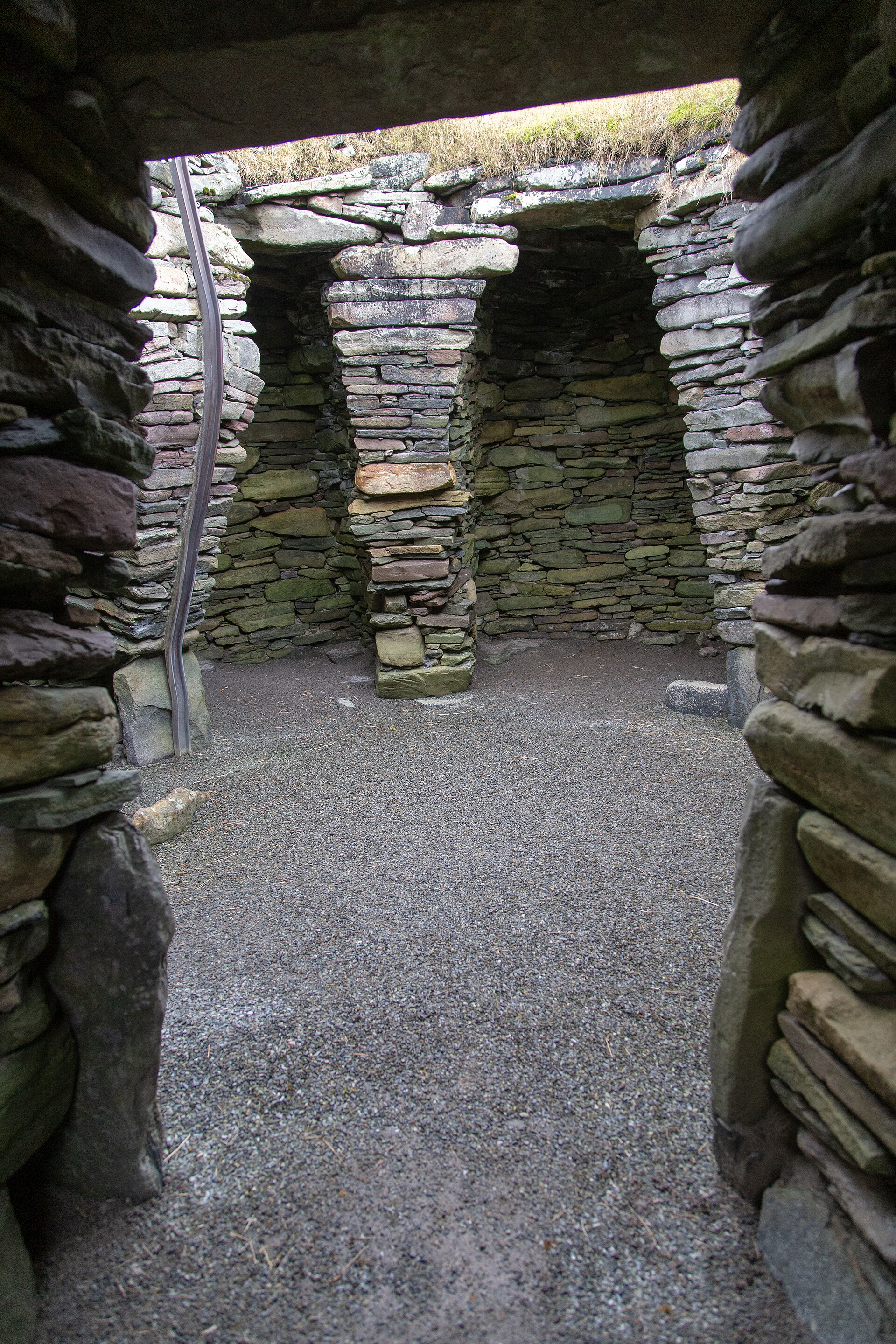
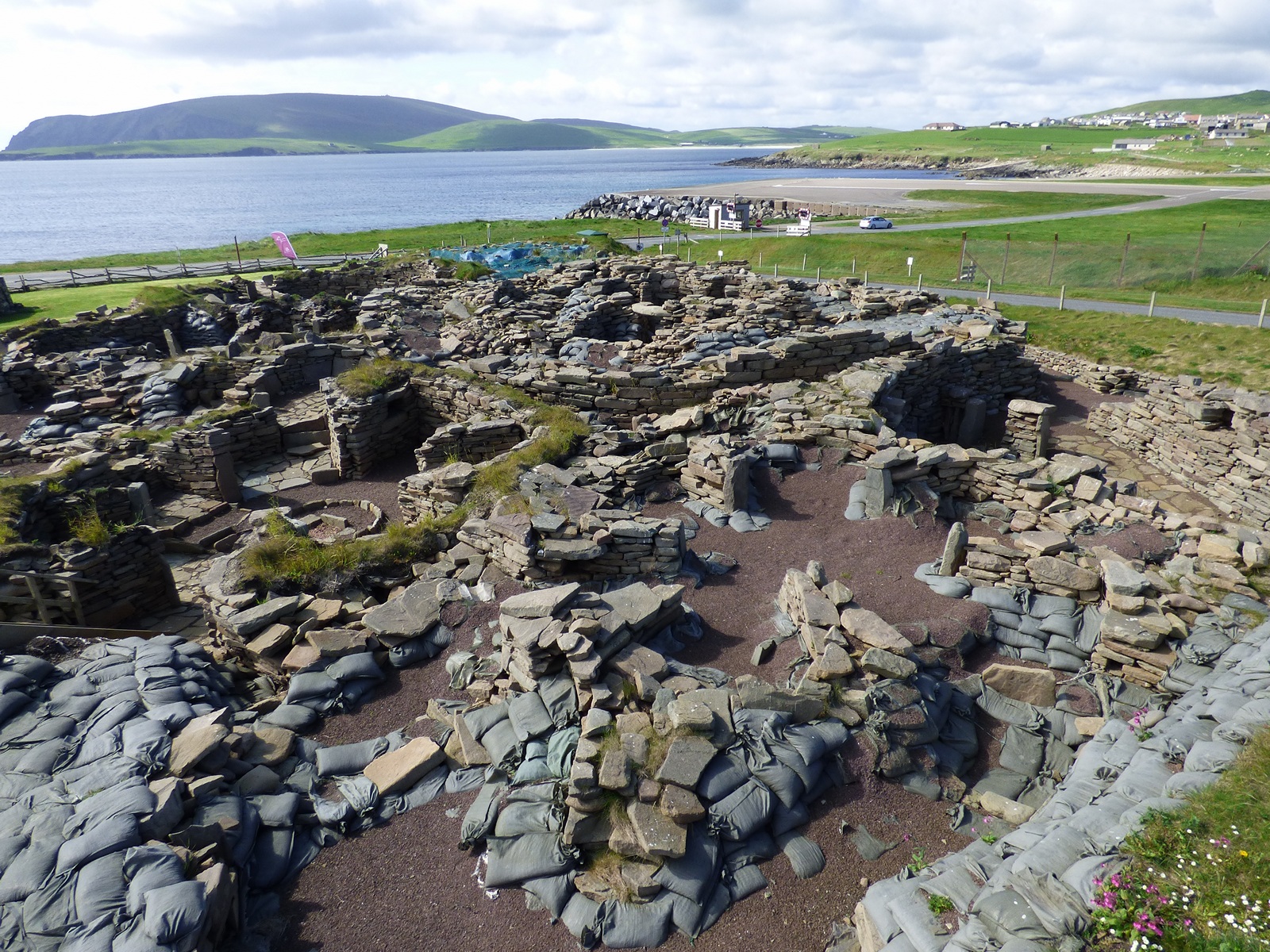
Jarlshof preserves an unusually complete sequence of human occupation, with remains dating from about 2500 BC to the 17th century AD — Bronze Age oval houses and a smithy, an Iron Age broch and roundhouses, a complex of Pictish wheelhouses, a Viking longhouse settlement, and a Scottish-period fortified manor.
The site remained largely hidden until a storm in the late 19th century washed away part of the shore and revealed the buried buildings. Formal excavation began in 1925, soon uncovering Bronze Age relics.
Jarlshof was one of the first two broch sites to be excavated using modern scientific techniques, between 1949 and 1952, revealing a complex sequence of construction from different periods. No further excavations have been undertaken since the early 1950s, and no radiocarbon dating has been attempted.
The Old House of Sumburgh began as a medieval stone farmhouse, was converted into a fortified house in the 16th century by Robert Stewart, 1st Earl of Orkney (who named it 'New Hall'), modernised by his son Patrick Stewart, 2nd Earl of Orkney (who renamed it the 'Old House of Sumburgh'), and was abandoned in the late 17th century.
In 2012 Jarlshof, Mousa and Old Scatness were added to the UK's tentative list of proposed World Heritage Sites under the title the 'Zenith of Iron Age Shetland'.
People
-
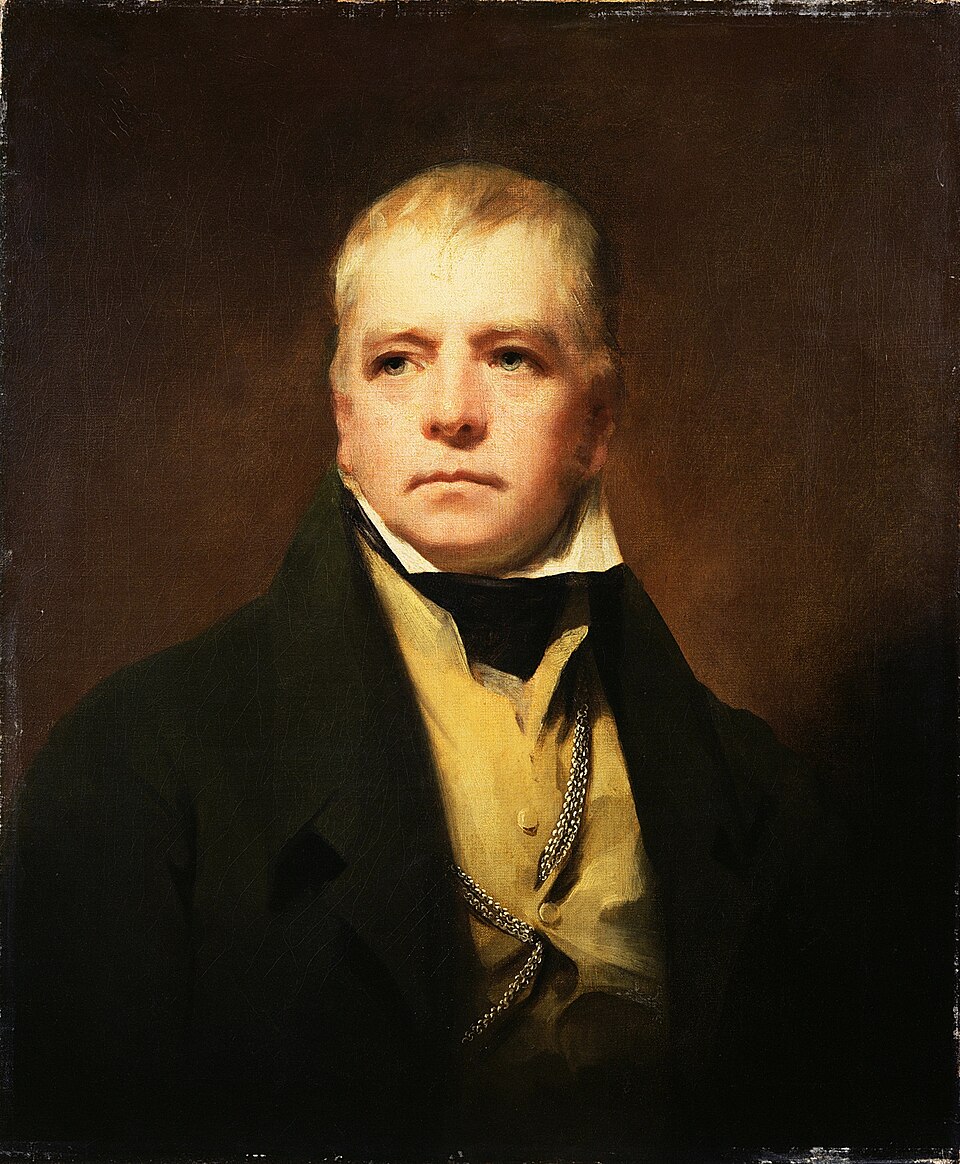
Portrait: Henry Raeburn / Wikimedia Commons / Public domain Walter Scott
Coined the name 'Jarlshof' after visiting in 1814 and used it in his 1821 novel The Pirate
-
Alexander (Alex) Curle
Archaeologist whose 1930s excavations found the first confirmed Norse longhouse in the British Isles
-
Robert Stewart, 1st Earl of Orkney
Converted the medieval farmhouse into a 16th-century fortified house ('New Hall')
-
Patrick Stewart, 2nd Earl of Orkney
Modernised the manor in the early 17th century, renaming it the 'Old House of Sumburgh'
Cultural influences
-
The Bronze Age oval houses show similarity to Skara Brae in Orkney but are smaller and later; broken moulds from the smithy indicate the smith was trained in the Irish style of metalworking.
-
The wheelhouse complex post-dates the main 1st-century-BC to 2nd-century-AD flourishing of these structures in the Western Isles by several centuries; unlike many Scottish wheelhouses built into the earth, the Jarlshof examples were built from ground level upwards.
-
Continuity and overlap between cultures is visible: Pictish-style drawings appear in the Viking levels, Viking-style loom weights and vessels were found alongside Pictish-design objects, and the basement courses of the rounded Pictish and rectangular Norse buildings are constructed in the same way.
Connections
-
Old Scatness
Broch and settlement of similar longevity just a mile (1.5 km) away, discovered in 1975
-
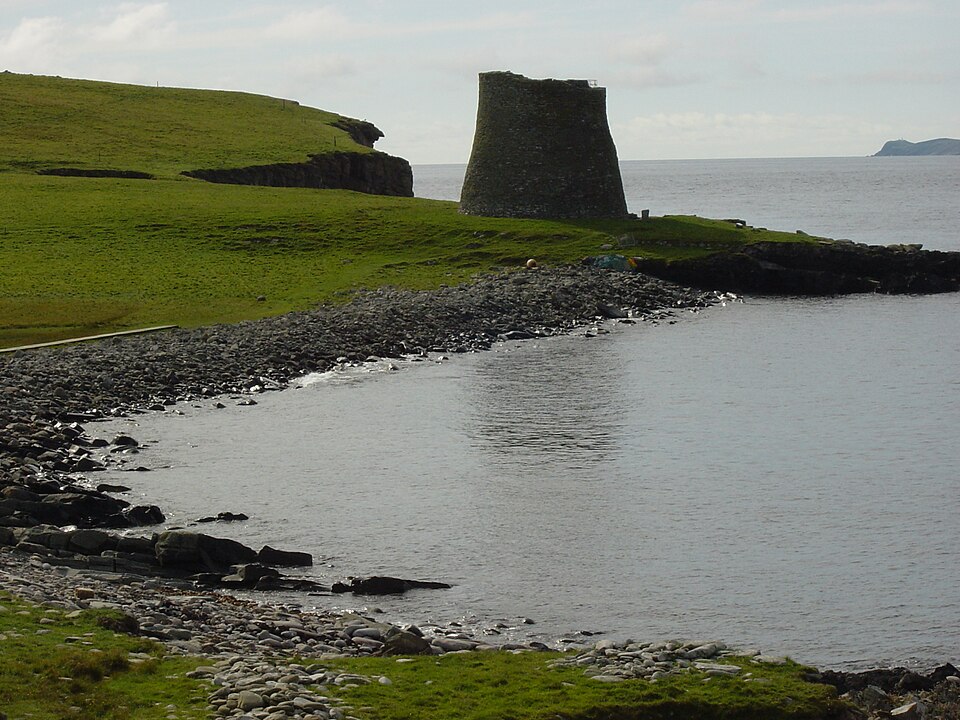
Photo: Langus (talk) / Wikimedia Commons / Public domain Broch of Mousa
Grouped with Jarlshof in the 'Zenith of Iron Age Shetland' tentative World Heritage proposal
-
Skara Brae, Orkney
Comparison for the Bronze Age oval houses, which resemble it on a smaller, later scale
-
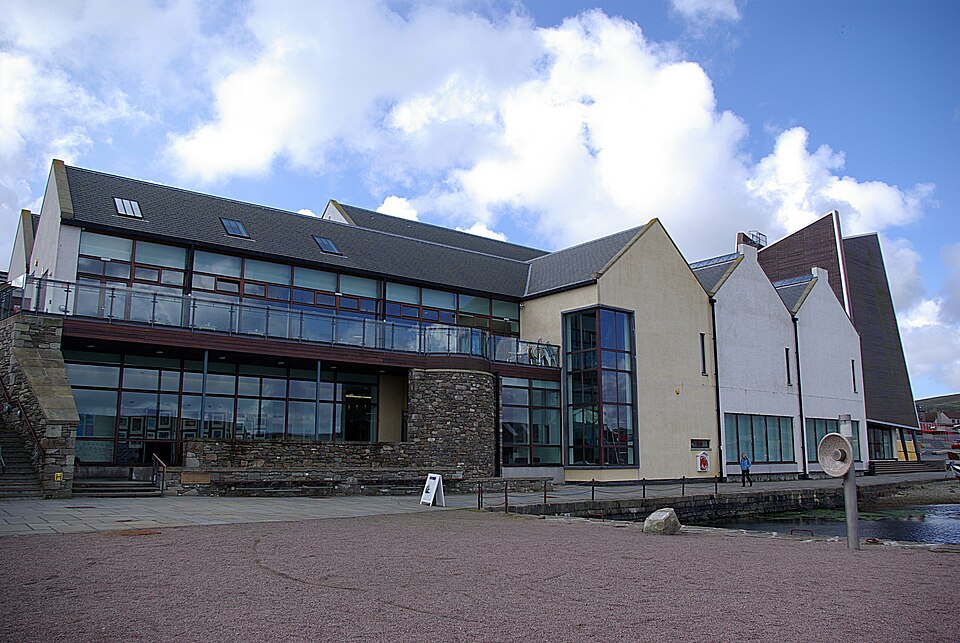
Photo: Clemensfranz / Wikimedia Commons / CC BY-SA 3.0 Shetland Museum
Holds many of the artefacts excavated from the Norse period, including an 8th–9th-century Irish-made bronze-gilt harness mount
Discovery & excavation
First revealed by storm erosion in the late 19th century, Jarlshof was excavated from 1925 (Bronze Age relics), in the 1930s by Alex Curle (the first confirmed Norse longhouse in the British Isles), and 1949–52 (the broch). Finds include a decorated Bronze Age bone 'plaque' with three bored holes and linear patterns, a bronze dagger and casting moulds for axes, knives, swords and pins; a Pictish painted pebble bearing a cross and S-shaped scrolls; one of only two Pictish symbol stones found in Shetland (double-disc and Z-rod); about 150 Norse loom weights; iron tools of bog-iron; and slate drawings of dragon-prowed ships and human and animal figures.
Finds now held at: Shetland Museum; On-site visitor centre at Jarlshof.
In culture
-
Walter Scott set part of his 1821 novel The Pirate in the Old House of Sumburgh, which he named Jarlshof — the coinage that gave the whole site its enduring name.
-
Described as 'one of the most remarkable archaeological sites ever excavated in the British Isles' and widely regarded as the best-known prehistoric site in Shetland, containing the most extensive Viking-Age remains visible anywhere in Britain.
What to look for
-
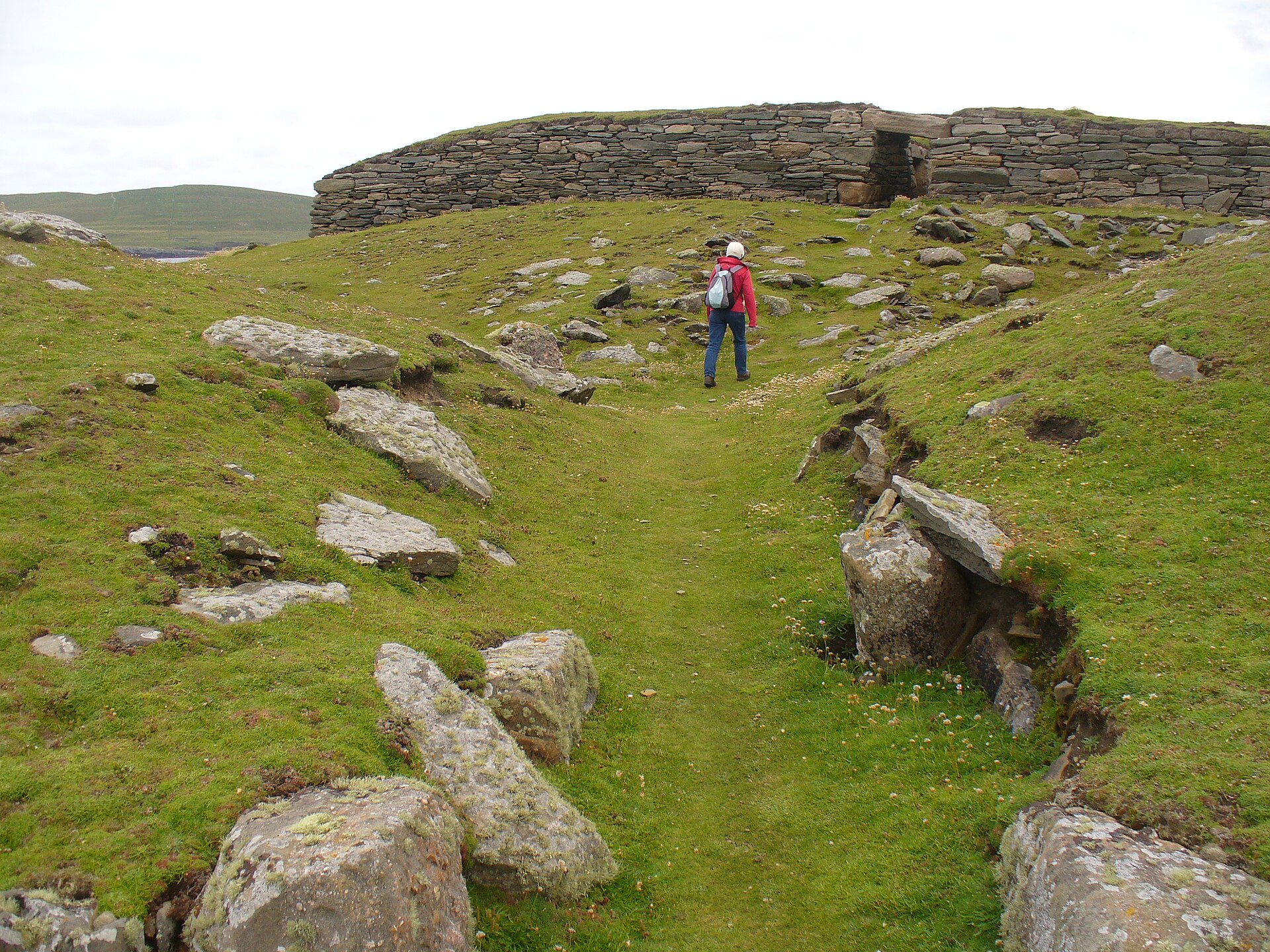
The Iron Age broch — part lost to coastal erosion and now protected by sea defences — which probably once stood 13 m (40 ft) or more high.
-
The complex of Pictish wheelhouses, two of which are among the best examples of their type; the best-preserved retains much of its stone roof and a series of corbelled bays.
-
The Viking longhouse settlement — seven Norse-era houses (no more than two in use at a time), the largest a 20-by-5-metre hall with central hearth and timber benches.
-
The walls of the Scottish-period fortified manor (the Old House of Sumburgh / Jarlshof House), the most visible structures on the site.
-
The Bronze Age oval houses and smithy, including a whale vertebra set into a wall, thought to have served as a tethering post.
Standing there
- The site sits low on a treeless coastal headland at the southern tip of Shetland Mainland, overlooking the West Voe of Sumburgh — wind, the cry of seabirds and the smell of salt and turf dominate, and the same storm-driven sea that buried the buildings in sand also tore them open again in the late 19th century.
- Walking the site you step physically through thousands of years: from Bronze Age oval houses and a smithy, past the Iron Age broch stump and the corbelled stone bays of the Pictish wheelhouses, into the Norse longhouses, and out at the tall walls of the 16th-century laird's manor — the layers stacked and overlapping in one compact ground.
- You can duck into the best-preserved wheelhouse, which still keeps much of its stone roof and a ring of corbelled bays, and stand inside the largest Norse hall — a 20-by-5-metre rectangular room that once had timber benches along each long wall and a hearth burning in the centre.
- In the Norse centuries this was a smoky, working farmstead under ridged timber-and-turf roofs — the air carrying peat-smoke and the wet-wool smell of the wool trade behind 150 surviving loom weights, with cod, saithe and ling drying from deep-water fishing and sheep, cattle, pigs and ponies kept close by.
- The Bronze Age corner brings the work of the place close: a smithy whose moulds show axes, knives, swords and pins being cast in the Irish style, the ring of metalwork and the heat of the forge, and a whale vertebra set into a wall thought to have served as a tethering post for cattle.
Plan your visit
- Location
- 59.8694°N · 1.2910°W
- Nearest settlement
- Sumburgh
- Access
- Paid entry — managed visitor site
- Terrain
- Moderate walking
- Parking
- Parking available nearby — see the official getting-here page.
- Start point
- Sumburgh · Shetland · ZE3 9JN · National Grid reference: HU 399 095 · [](https://www.goodjourney.org.uk/attractions/jarlshof/)
- Start point
- Jarlshof visitor car park, Sumburgh — Car park adjoining the Jarlshof visitor centre at Sumburgh, beside the Sumburgh Hotel.
- Sat-nav
- ZE3 9JN
Opening & admission
Free entry
Nearby places
Sources
- Canmore site record 513 (accessed 2026-06-13)
- Wikipedia: Jarlshof (accessed 2026-06-13)
- Wikidata Q1683532 (accessed 2026-06-13)
Explore more: Settlements · Prehistoric · Shetland Islands
The Ancient Codex, in your pocket
Get the Pocket Codex app
Carry the directory with you — Jarlshof and thousands of ancient places across Britain and Ireland, offline, wherever you roam.