
The broch is thought to have been built around c. 300 BC, during the later Scottish Iron Age, as one of more than 500 brochs raised across Scotland.
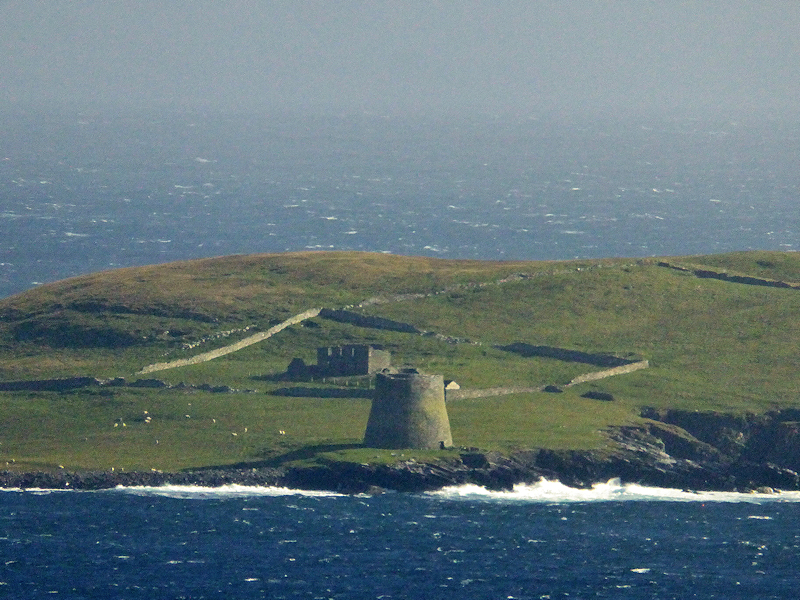
Broch (an Iron Age drystone round tower) of Mousa is a fortified place near Sandwick, Shetland, Scotland.
What follows is drawn from published sources, with each claim labelled by how firmly it is established.
History
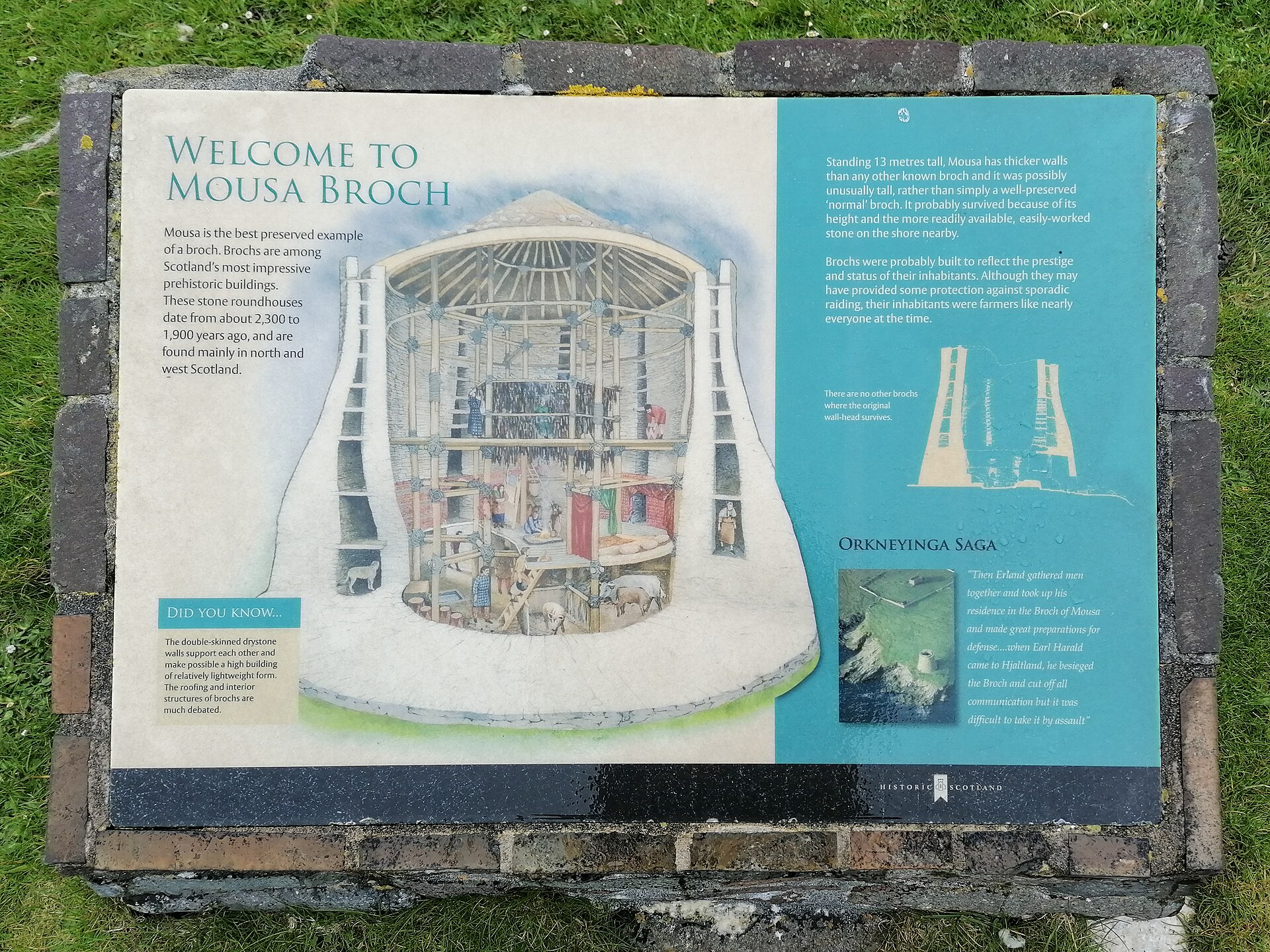
The broch is thought to have been built around c. 300 BC, during the later Scottish Iron Age, as one of more than 500 brochs raised across Scotland.
The tower went through at least two phases of occupation; in a later Iron Age alteration any earlier internal timber roundhouse was replaced by a small wheelhouse with three projecting stone piers.
The broch features in two Norse sagas: Egil's Saga tells of a couple eloping from Norway to Iceland who were shipwrecked and sheltered in it, and the Orkneyinga Saga records a siege of the broch by Earl Harald Maddadsson in 1153 after the abduction of his mother, who was held inside.
The interior was first cleared of accumulated rubble in 1861, more than two thousand years after the broch was built; further clearing by the Office of Works followed in 1919.
Major stabilisation was undertaken between 1967 and the 1980s, and in 2005 archaeologists used 3D laser scanning to document the structure and support conservation planning.
People
-
Earl Harald Maddadsson
Earl of Orkney who, per the Orkneyinga Saga, besieged the broch in 1153
-
George Low
Antiquarian who visited in 1774 and made the first drawings of the broch
-
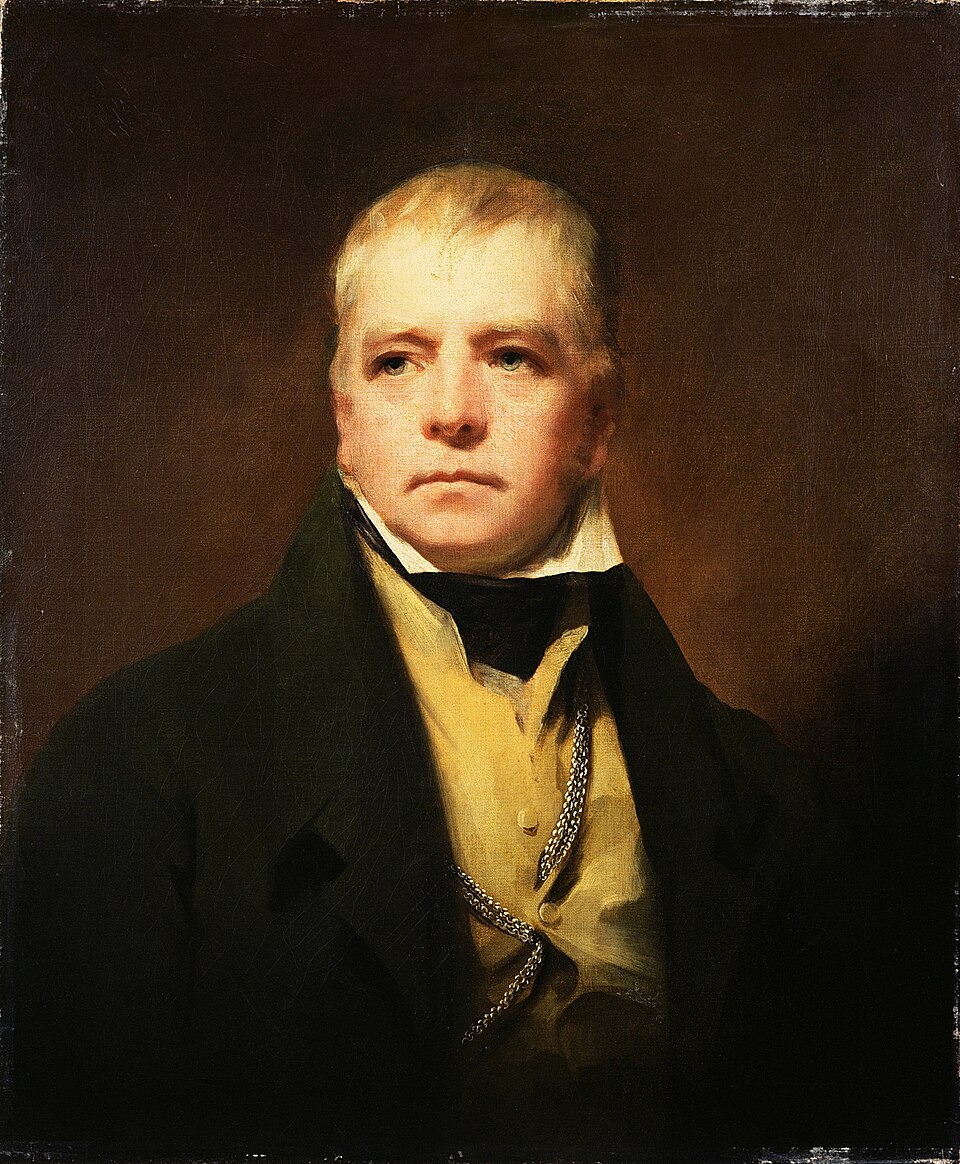
Portrait: Henry Raeburn / Wikimedia Commons / Public domain Sir Walter Scott
Visited in 1814 and described it as 'a Pictish fortress, the most entire probably in the world'
-
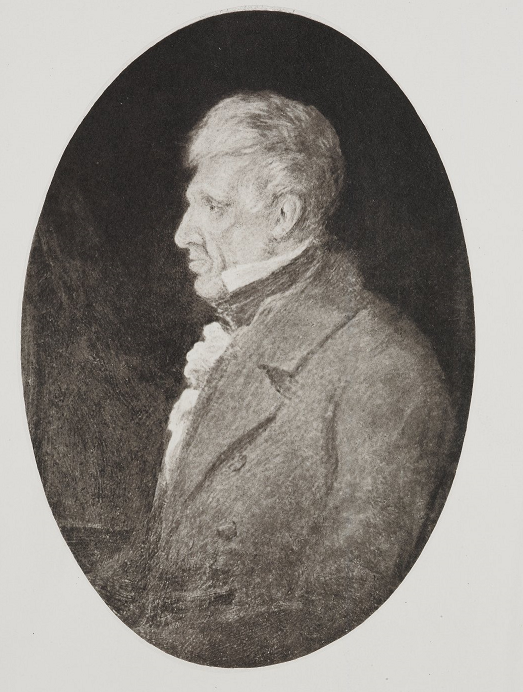
Portrait: Mrs Mary Clementina Hibbert Ware / Wikimedia Commons / Public domain Samuel Hibbert
Geologist and antiquarian who visited in 1818 and gave a detailed account
-
Sir Henry Dryden
Conducted the first accurate survey of the broch in 1852 and 1866
Cultural influences
-
Atlantic broch architecture taken to its extreme — one of the smallest overall diameters and smallest interiors of any broch but one of the thickest wall bases, a massive drystone construction (with no mortar) credited, along with its remote location, for its survival.
-
Norse saga tradition — its appearance in both Egil's Saga and the Orkneyinga Saga shows the tower remaining a notable landmark and refuge long into the medieval period.
-
A maritime Iron Age landscape — built on a low coastal promontory beside the sheltered Loch of Mousa, commanding wide views over Mousa Sound, within a wider Shetland landscape rich in brochs and settlements.
Connections
-
Mousa Sound
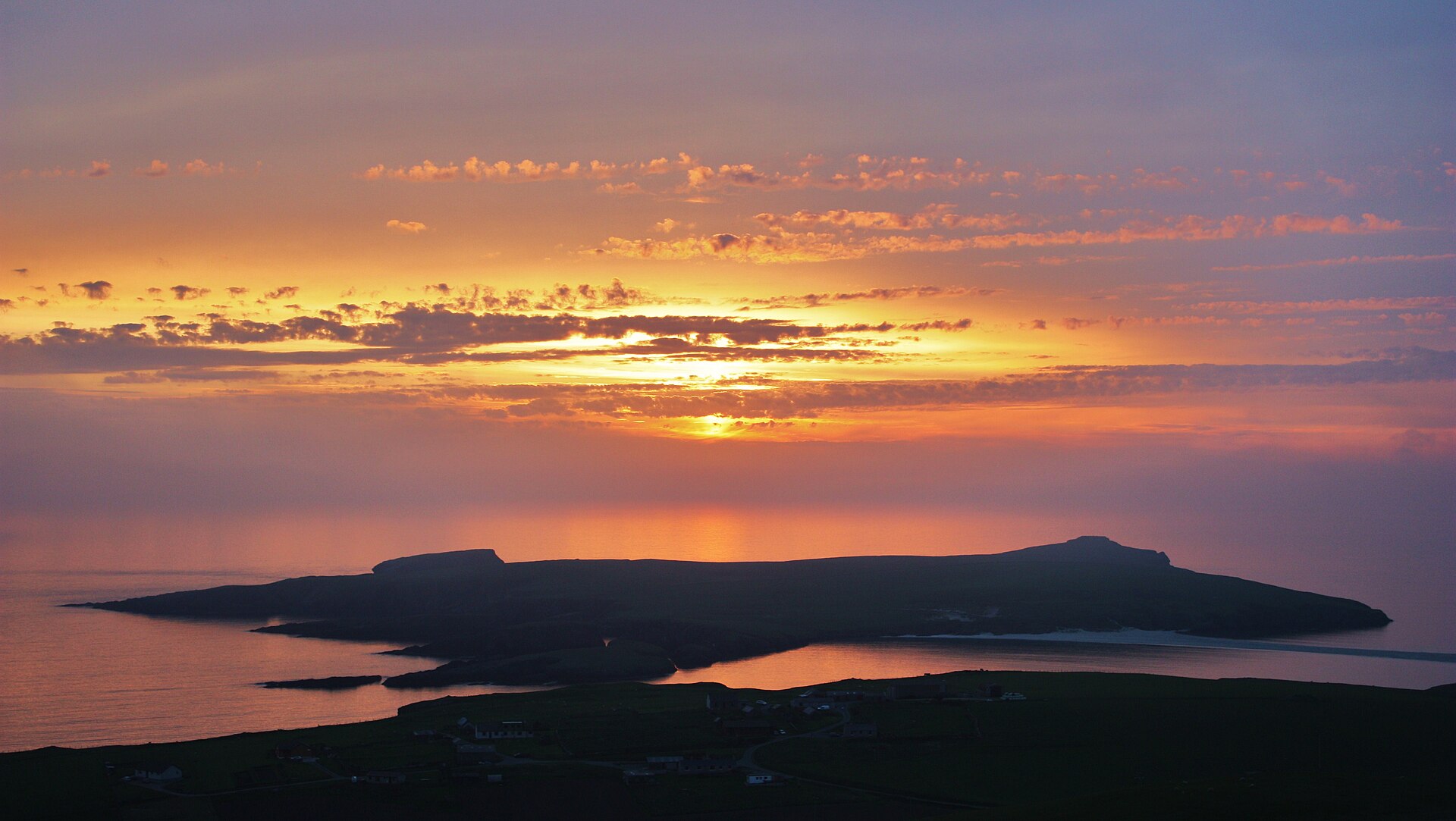
The narrow stretch of water the broch overlooks, separating Mousa from the South Mainland of Shetland
-
Clickimin Broch
Paired with Mousa in John Hamilton's study 'The Brochs of Mousa & Clickhimin' (1970)
-
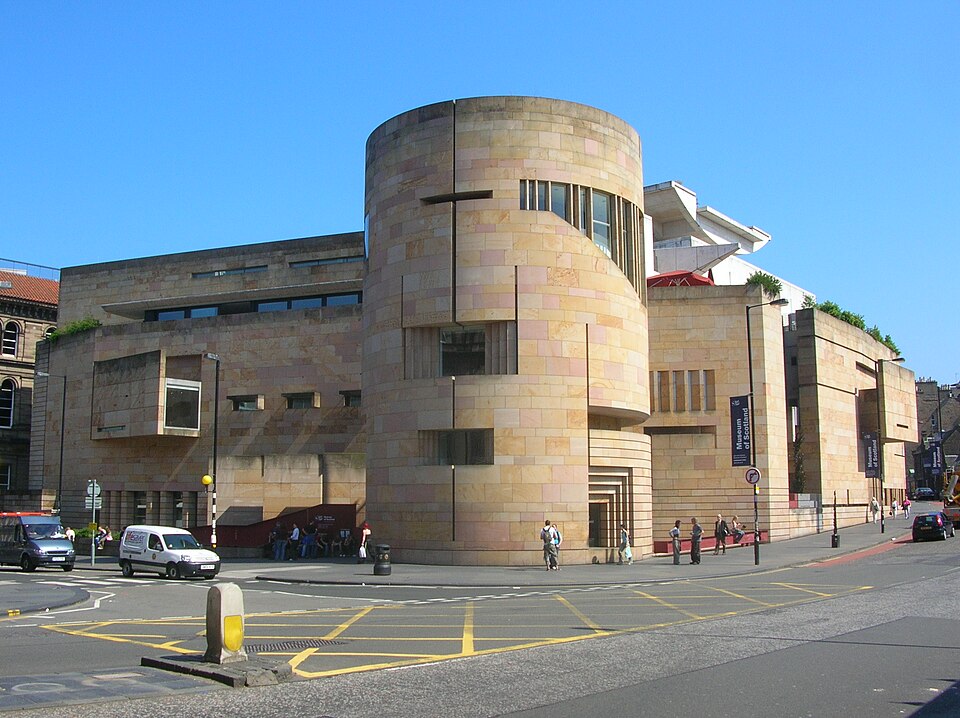
Photo: No machine-readable author provided. Maccoinnich~commonswiki assumed ( / Wikimedia Commons / CC BY-SA 3.0 National Museum of Scotland
Holds pottery sherds recovered from the broch, including part of a Black-burnished ware vessel
Discovery & excavation
Because the broch survives almost intact, investigation has focused on recording the standing architecture rather than large-scale excavation. The 1861 clearance recovered large quantities of animal bones (notably of otters that had inhabited the abandoned tower), pottery fragments, stone pot lids, a slaty object resembling a triangular file, and — most unusually — a carved wooden model of a Norwegian boat about 0.9 m long, made of fir. The 1919 clearance recovered relatively little more; some pottery sherds, including part of a Black-burnished ware vessel, are now held in the National Museum of Scotland.
Finds now held at: National Museum of Scotland (pottery sherds incl. Black-burnished ware).
In culture
-
The tallest broch still standing (13.3 m) and among the best-preserved prehistoric buildings in Europe — the only broch complete nearly to the top, including its original intramural stair.
-
It has been the subject of architectural study from George Low's 1774 drawings onward, and in 2011 of an investigation into the aural space inside the broch through analysis of sound and light.
-
Well known among birders: the broch and island hold breeding European storm petrels — around 6,800 pairs on Mousa, about 8% of the British population — some nesting in burrows within the broch itself, best seen on dark overcast summer nights.
What to look for
-
The single ground-level entrance on the west side, with a 5 m entrance passage that still retains an original bar-hole.
-
The internal intramural staircase — beginning at the second level — that can be climbed nearly to the top of the 13.3 m tower.
-
In the central court: a hearth, a stone floor tank, and a low stone bench running around the base of the inner wall (an early alteration).
-
Three ground-floor cells built into the wall thickness, entered through thresholds 0.7 m above floor level, with openings above each lintel for light and air and recesses set into the wall.
-
Six galleries between the two concentric upper walls, partly lit by voids and walkable along most of their length, with scarcement ledges at about 2.1 m and 3.7 m.
What is said
Folklore and tradition, recorded as what is said — not as established fact.
-
Egil's Saga relates that a couple eloping from Norway to Iceland were shipwrecked and used the broch as a temporary refuge. (recorded in a Norse saga)
Standing there
- Reached only by boat across Mousa Sound to a small, flat, treeless island of grass and heath, the broch rises 13.3 metres straight off a low rock shore — the tallest broch still standing — so your first sense of it is its sheer intact height against open sky, sea-wind and the wash of the sound.
- You enter through a single low west-facing doorway and a 5-metre passage that still holds its original bar-hole, into a circular court open to the sky, where a hearth, a stone floor-tank and a low stone bench around the inner wall mark where people actually lived inside the tower.
- From the court you can climb the original intramural stone stair, curving up between the broch's two concentric drystone walls past dim galleries lit only by narrow voids, until you emerge at the top with much of Mousa Sound and the South Mainland coast laid out below — the same commanding sea-view its Iron Age builders had.
- On dark, overcast summer nights the broch becomes an extraordinary soundscape: thousands of European storm petrels — Mousa holds around 6,800 breeding pairs — return after dark to nest in the island's burrows and in the broch's own drystone walls, filling the night with their churring calls.
- Sheltering inside in the Iron Age would have been close and dim — a fire on the central hearth, the smell of smoke and damp stone, small wall-cells reached over raised thresholds for storage — a refuge whose strength still read in the Norse age, when sagas record a shipwrecked eloping couple sheltering here and a 1153 siege of the tower.
Plan your visit
- Location
- 59.9953°N · 1.1821°W
- Nearest settlement
- Sandwick
- Access
- Reached on a public path
- Terrain
- Moderate walking
- Start point
- Sandsayre Pier, Leebitton (Sandwick) — Mousa ferry departure — Mousa cannot be reached on foot. The Mousa Boat ferry departs the historic Sandsayre Pier at Leebitton, Sandwick, on the Shetland Mainland (small visitor centre at the pier). Ferry is seasonal and weather-dependent; the figure shown is the straight-line sea distance from the pier to the broch, NOT a walk. There is a car park at the pier.
Nearby places
Sources
- Canmore site record 944 (accessed 2026-06-13)
- Wikipedia: Broch of Mousa (accessed 2026-06-13)
- Wikidata Q923376 (accessed 2026-06-13)
Explore more: Fortified places · Iron Age · Shetland Islands
The Ancient Codex, in your pocket
Get the Pocket Codex app
Carry the directory with you — Broch of Mousa and thousands of ancient places across Britain and Ireland, offline, wherever you roam.