
A weathered kite-shaped slab from a field-clearance heap became a museum-held Pictish find. The Cairnton Stone is a Class I Pictish stone, an early symbol stone without a cross, discovered at Cairnton Farm near Newmachar in 2001.
The carvings appear on one face of a natural slab and are dated to the seventh century. After discovery the stone was declared Treasure Trove and entered the Marischal Museum collection in Aberdeen.
What follows is drawn from published sources, with each claim labelled by how firmly it is established.
History
The Cairnton Stone was discovered in 2001 at Cairnton Farm near Newmachar.
It was found lying in a large field-clearance heap.
The stone is a kite-shaped natural slab.
The carving appears on one weathered face.
The incised symbols are the crescent and V-rod and the triple disc.
The stone is dated to the seventh century.
It was declared Treasure Trove after discovery.
The Cairnton Stone is now in the collection of the Marischal Museum, Aberdeen.
Plan your visit
- Location
- 57.2678°N · 2.2386°W
- Access
- Open access
- Terrain
- Easy going
Opening & admission
The source pack identifies a museum-held object but does not provide current opening or admission details; check the museum before travelling.
- The stone is now in the Marischal Museum collection, not at its findspot.
Nearby places
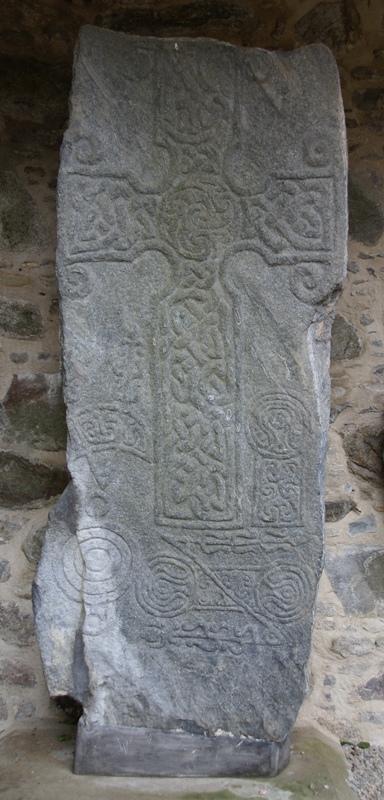
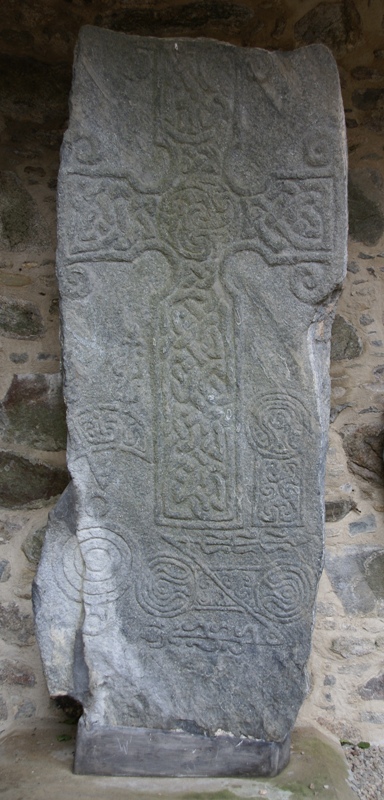
Carved stone · Pictish & early medieval
Dyce Symbol Stones
Aberdeen City
- Near Dyce
- 1 min walk from car park
- Easy path
Questions people ask
- What is the Cairnton Stone?
- It is a seventh-century Class I Pictish symbol stone from Cairnton Farm near Newmachar.
- Where was it found?
- The pack says it was discovered in 2001 in a large field-clearance heap.
- What symbols are on it?
- It bears the crescent and V-rod and triple disc symbols.
- Where is it now?
- It is in the collection of the Marischal Museum in Aberdeen.
Sources
Explore more: Carved stones · Pictish & early medieval · Aberdeenshire
The Ancient Codex, in your pocket
Get the Pocket Codex app
Carry the directory with you — Cairnton stone and thousands of ancient places across Britain and Ireland, offline, wherever you roam.